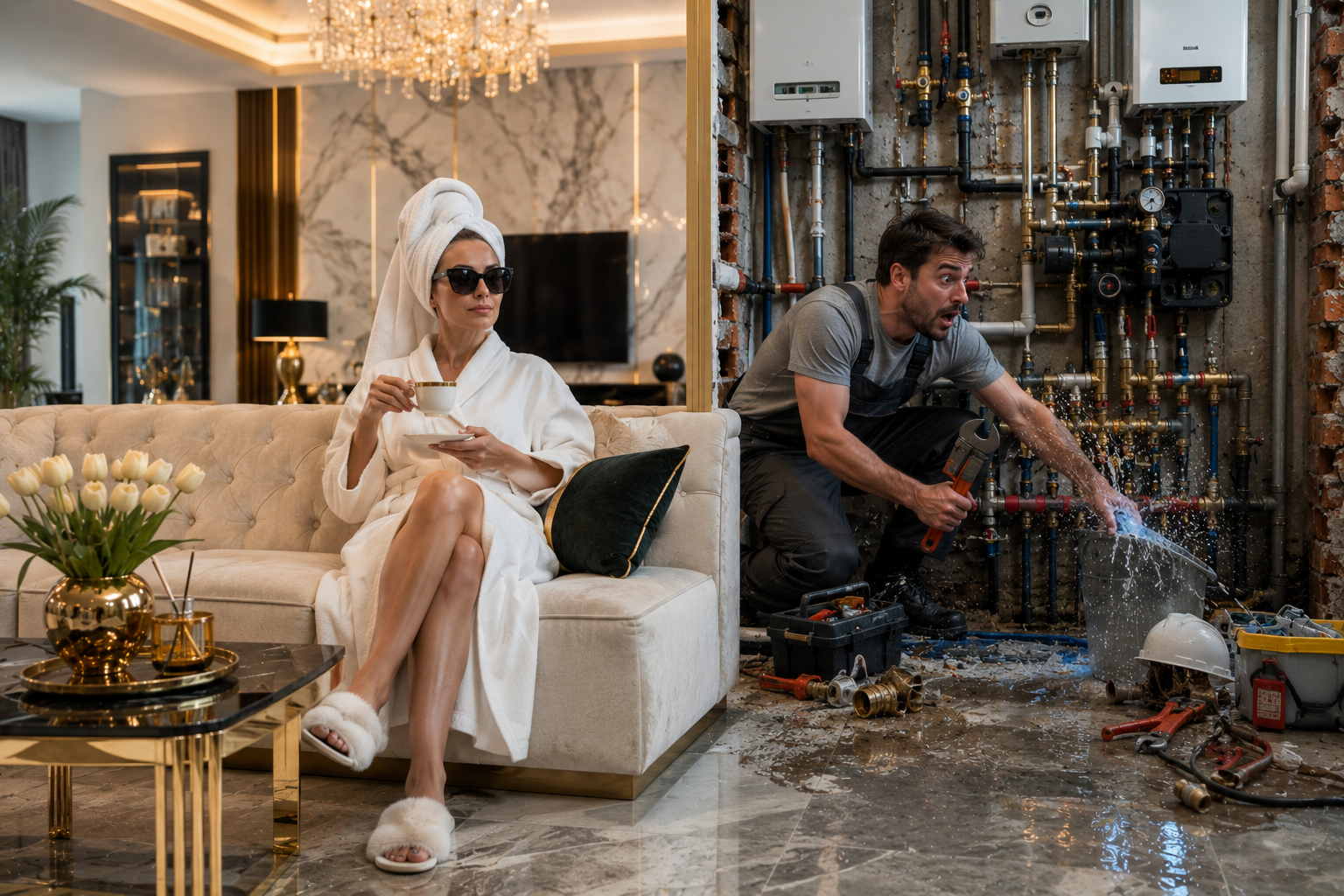


The ostrich syndrome applied to home building systems
There’s a universal human behavior, rooted in our DNA since cave times. When something isn’t staring us straight in the face, we pretend it doesn’t exist. That’s the ostrich syndrome. We apply it to taxes, we apply it to medical checkups and, above all, we apply it to the systems in our homes. Does the boiler heat the water? Perfect. I don’t think about it anymore. Do the AC units blow cold air? Fantastic. I don’t touch them. Do the lights turn on? Great. I don’t worry.
The problem is that systems aren’t static entities. They’re not paintings hanging on a wall. They’re dynamic organisms. They’re made of moving parts, flowing fluids, traveling electrons, and chemical reactions happening in silence. And like all organisms, they age. They wear out. They get sick. Ignoring maintenance doesn’t mean “saving time.” It simply means postponing the problem. And when the problem shows up, it doesn’t politely knock at the door. It kicks the door in, wrecks the living room, and hands you a very expensive bill. Today we’ll explain, with the right dose of cynicism and technical rigor, what it really costs you to ignore maintenance. Spoiler: it costs you far more than you think.
The “Total Cost of Ownership” philosophy (or the art of throwing money away)
To understand the mistake, we need to change paradigm. Most people look only at the purchase or installation price. “How much does it cost me to install this system?” That’s the wrong question. The right question—the one engineers and CFOs at big companies ask—is: “How much does it cost me to own and run this system over its entire useful life?”
It’s called TCO, Total Cost of Ownership. TCO includes the initial cost, the cost of energy consumed, the cost of extraordinary repairs and, of course, the cost of routine maintenance. If you buy a car and never change the oil, the car breaks after thirty thousand kilometers. You saved two hundred euros on servicing, but you lost five thousand buying a new engine. With home systems it’s exactly the same. Maintenance isn’t an expense. It’s an investment with guaranteed returns. It’s the only budget line that protects you from financial disaster.
The heating system: the thermodynamics of limescale and sludge
Let’s start with the boiler or the heat pump. Your heat generator works in a hostile environment. The water circulating in the pipes isn’t lab-distilled water. It’s tap water. It contains mineral salts, mainly calcium and magnesium. When water heats up, these salts precipitate and form limescale.
Limescale is a formidable thermal insulator. Just two millimeters of limescale in your boiler’s heat exchanger are enough to increase gas consumption by 8–10%. Let’s do the math. If you spend €1,500 a year on gas, limescale is burning €150 every winter. In ten years, you’ve literally thrown €1,500 up the flue. The cost of a chemical flush treatment and a water softener? A fraction of that amount.
But it’s not only limescale. There’s sludge. Iron or steel pipes, over time, corrode internally. Iron oxides form, detach, and circulate through the system. This black, dense sludge clogs radiators (which stay cold at the bottom) and, worse, destroys the circulation pump and thermostatic valves. A modern heat pump, which costs thousands of euros, can burn out its plate heat exchanger in a few months if sludge isn’t removed with a magnetic dirt separator and a system flush. Ignoring thermo-hydraulic maintenance means paying twice: once on the bill, and once in repairs.
Bureaucracy will save your life (and your wallet): DM 10/2014
Many see the “blue sticker” or the annual boiler check as a hidden tax invented by the State to torment citizens. In reality, it’s a vital safety rule. Ministerial Decree 10/2014 regulates the maintenance of thermal systems. It requires the owner to keep the System Logbook up to date and to have energy-efficiency checks carried out regularly (usually every two or four years, depending on power and fuel).
Why is it important? Because a qualified technician doesn’t just check whether the flame is blue. They check combustion. They measure the percentage of carbon monoxide (CO) in the exhaust fumes. A poorly adjusted boiler or one with a dirty exchanger can start releasing carbon monoxide into the room. Carbon monoxide is odorless, colorless, and lethal. Annual maintenance isn’t to make the technician happy. It’s to make sure you wake up alive the next morning. Also, in case of an accident, if you don’t have the logbook updated, your criminal and civil liability is total. The insurance won’t pay a cent.
The electrical system: the Joule effect and killer dust
Let’s move to the electrical system. “But the electrical system doesn’t move, it doesn’t wear out—what do I need to maintain?” That sentence has caused more house fires in human history. The electrical system is subject to two invisible enemies: heat and dust.
Electrical connections, over time and due to micro-vibrations or thermal expansion, can loosen. A loose terminal increases electrical resistance. According to the Joule effect, when current passes through a resistance, it generates heat. This heat overheats the terminal, which loosens even more, generating even more heat. It’s a vicious circle that ends with melted insulation, electrical arcing and, often, a system fire.
Dust, then, is another silent killer. Dust accumulated in electrical panels, especially in humid environments, becomes conductive. It can create micro short-circuits between phases. Professional electrical maintenance doesn’t mean only “tightening screws.” It means using a thermal camera. The thermal camera sees heat. A qualified technician scans the panel under load and immediately identifies hot spots, fixing the issue before it becomes a blaze. Doing this thermographic analysis every three or five years costs a few hundred euros. Rewiring after a fire costs tens of thousands.
Air conditioning and Heat Pumps: the triumph of biology
The air conditioner or heat pump in cooling mode has a delicate task: removing humidity from the air. The water extracted from the air condenses on the indoor unit coil. This coil is dark, damp, and rich in nutrients (the dust you suck in). It’s the perfect habitat for bacteria, fungi, and molds.
If you don’t clean and sanitize the indoor coils, you’re not just breathing bad air. You’re breathing a biological cocktail. In extreme cases, this environment favors the proliferation of Legionella pneumophila, a bacterium that, if dispersed into the air through condensation droplets, can cause a severe form of pneumonia.
And it’s not only about health. A dirty coil blocks airflow. The fan struggles. The compressor works harder to exchange heat. Efficiency (COP and EER) collapses. You use 20% more electricity to get the same temperature. Cleaning the filters every month is a DIY task. But sanitizing the coils, cleaning the condensate trays, and checking the refrigerant gas charge requires a technician. Ignoring it means turning your AC into an expensive disease diffuser.
VMC: the lungs of the house that silently choke
Controlled Mechanical Ventilation (VMC) is the ultimate solution for air quality. But it’s also the system most betrayed by maintenance. VMC constantly draws in air. Filters stop pollen, dust, and smog. Over time, filters clog.
If you don’t change VMC filters every six months, the machine has to strain to pull air through a wall of dirt. The motor burns out. But there’s worse. If the filters are clogged, the machine stops exchanging air. The house becomes airtight. Humidity rises. CO2 shoots through the roof. Mold starts blooming again in the corners of the walls. You spent five thousand euros on a VMC to avoid mold, and by not changing two-hundred-euro filters, you turned it into a very expensive mold-making machine. VMC maintenance is simple, but it’s mandatory. It’s not optional.
The math of disaster: the hidden costs of plumbing leaks
The plumbing system is under pressure. Twenty-four hours a day, seven days a week. Seals dry out. Fittings loosen. Pipes made of old materials corrode. A leak is never “just a drip.”
One drop per second is about thirty liters of water a day. Nine hundred liters a month. If the leak is hidden, inside the screed, the water doesn’t stop. It soaks the thermal insulation, which loses its properties. It wets electrical conduits, creating short-circuit risks. And, above all, it goes down to the floor below.
The cost of preventive plumbing maintenance (pressure check, inspection with thermal camera or tracer gas, replacement of flexible hose seals) is negligible. The cost of water damage? Demolition of the floor, rebuilding the screed, restoring tiles, compensation to the neighbor for damage to the ceiling and furniture, increased insurance premium. We’re easily talking €15,000–€20,000 in damage. All because you didn’t replace a five-euro seal or didn’t have the system checked.
Insurance and “culpa in vigilando”: when saving turns into a conviction
Many think: “Relax, I have home insurance. If everything breaks, it pays.” Huge mistake. Insurance policies cover accidental and sudden damage. They don’t cover negligence.
If a pipe breaks because it was old and was never checked, the insurer can raise “culpa in vigilando” (fault in supervision). In plain words: “You knew, or should have known, the system was at risk, and you did nothing to prevent it.” The insurer denies compensation. And you have to pay out of pocket for your damage and your neighbor’s.
Having a maintenance record, with invoices and technicians’ reports certifying the system has been checked regularly, is your only protection against an insurance company refusal. Maintenance is the documentary proof of your diligence.
The myth of “DIY” and YouTube
We live in the YouTube era. One tutorial video is enough to feel like plumbers, electricians, and HVAC engineers. “Look, I can change the faucet seal in two minutes.” Sure. But do you know how to shut off the main water? Do you know what happens if the thread breaks inside the wall?
DIY is fine for changing a light bulb or assembling a small cabinet. It’s not fine for systems. A professional technician doesn’t use only their hands. They use diagnostic tools. They use a pressure gauge to test hydraulic tightness at 10 bar. They use a combustion analyzer for the boiler. They use a thermal camera for the electrical system. They use a sound level meter and a hygrometer for the VMC.
Entrusting maintenance to a professional doesn’t mean paying for their time. It means paying for their tools, their experience, and their ability to see a problem before it explodes. The technician doesn’t fix what’s broken. The technician prevents it from breaking.
Maintenance is the antidote to obsolescence
Ultimately, ignoring system maintenance is a bet. And like all bets, the house always wins. The house, in this case, is physics, chemistry, and the wear of time.
Maintaining systems means respecting the complexity of the modern home. It means protecting your real-estate investment. It means ensuring your family’s safety. It means, above all, sleeping soundly. There’s no greater luxury, in 2026, than peace of mind. The peace of mind of knowing the boiler won’t explode, the electrical panel won’t catch fire, and the bathroom won’t flood the neighbor. That peace of mind has a price. It’s called maintenance. And it’s the best deal you can make.
FAQ: The questions spinning in your head (and the answers that will save your life)
Is it true that if my system is new I don’t need maintenance for the first few years?
Absolutely not. This is a very dangerous urban legend. A new system needs more attention in the first years, not less. New thermal systems, for example, release machining residues, oxides, and impurities in the first months of operation. If you don’t do a flush and an initial check after the first year of break-in, these impurities settle and damage components. A new electrical system must be checked to verify that terminals have seated correctly after the first heating and cooling cycles. Maintenance doesn’t depend on the system’s age, but on its physical nature.
Can I do AC maintenance myself by cleaning the filters?
You can, and you should, clean the mesh filters of the indoor unit every two to four weeks during summer. You remove them, rinse them under running water, and put them back. It’s a great habit. But it’s not enough. Real professional maintenance requires opening the casing, chemical sanitization of the finned coil (where bacteria hide), cleaning the condensate tray, and checking refrigerant gas pressure. Cleaning filters is like brushing your teeth: useful, but it doesn’t replace a dentist visit.
What exactly are my legal obligations for the boiler?
The reference law is D.P.R. 74/2013 and D.M. 10/2014. You are required to appoint a “Third Responsible Party” (usually the maintenance technician) if the system is centralized, or to take direct responsibility if it’s independent. You must fill in and keep the System Logbook updated. You must have the energy-efficiency check (the famous “flue gas analysis”) carried out at the frequency set by the region (usually every 2 years for methane up to 35 kW, or every 4 years). The technician must record the outcome in the Logbook and, in many regions, upload it to the regional system registry. Ignoring these deadlines leads to heavy administrative fines, starting at €500 and reaching €3,000 for the owner.
How much does a truly complete annual maintenance plan cost?
The cost varies based on system complexity and area, but to give an order of magnitude: an annual boiler check with flue gas analysis and burner cleaning costs between €100 and €150. Sanitizing a split AC unit runs about €50–€80 per machine. Replacing VMC filters and checking the motor costs about €150–€200. A thermographic analysis of the electrical panel every three years costs about €200–€300. If you amortize these expenses annually, we’re talking about roughly €300–€500 per year to keep an average home healthy. Compare that with €15,000 in water damage or €2,000 for a boiler ruined by sludge. The return on investment is over 1000%.
Does my home insurance cover damage if I haven’t done maintenance?
In general, no. “Building” or “Family” policies cover accidental, sudden, and unforeseeable damage (e.g., lightning, an exceptional weather event, or a sudden manufacturing defect). If the insurance adjuster finds that the pipe that flooded the neighbor was corroded and hadn’t been checked for ten years, or that the boiler exploded because flue gas analysis wasn’t done, they will apply “recourse” or a total denial for the policyholder’s negligence (culpa in vigilando). Having invoices for periodic maintenance is the only way to prove to the insurer that you acted with the “diligence of a good family man” and obtain compensation.
How can I tell if the technician I call for maintenance is truly competent?
A competent technician doesn’t show up at your home with only a screwdriver. They arrive with a case full of instruments. For the boiler, they must have a certified, calibrated combustion analyzer. For plumbing, a pressure gauge for tightness tests. For electrical, a thermal camera and an insulation tester. For VMC, an anemometer to measure airflow rate. Also, a serious technician doesn’t just “make the machine work.” They explain what they found, show you the values (e.g., the CO percentage in the fumes, or the temperature of an electrical terminal), and recommend improvement actions. If the technician looks at the boiler for two minutes, writes two lines in the logbook, and leaves, you’re paying for a farce.
Stop waiting for disaster, start protecting your home
You’ve read this far and you’ve understood that maintenance isn’t a bureaucratic nuisance. It’s life insurance for your home and your wallet. Are you tired of living with the anxiety that something will break at the worst moment? Are you tired of seeing bills rise for no reason? Are you tired of risking your family’s health by breathing stale air?
It’s time to move from emergency management to prevention management.
Contact Gruppo Impianti ristrutturazioni today.
We’re not simple repairmen. We’re your home’s primary care doctors. We offer tailored scheduled maintenance plans for your systems: thermo-hydraulic, electrical, air conditioning and VMC. Our certified technicians will arrive with the most advanced diagnostic tools, produce detailed reports, and guarantee maximum efficiency, safety, and legal compliance. Don’t wait for the pipe to leak or the boiler to stop. Write to us, call us, or come visit us. We turn maintenance from an unexpected expense into a guaranteed investment. Your home deserves to be cared for.