
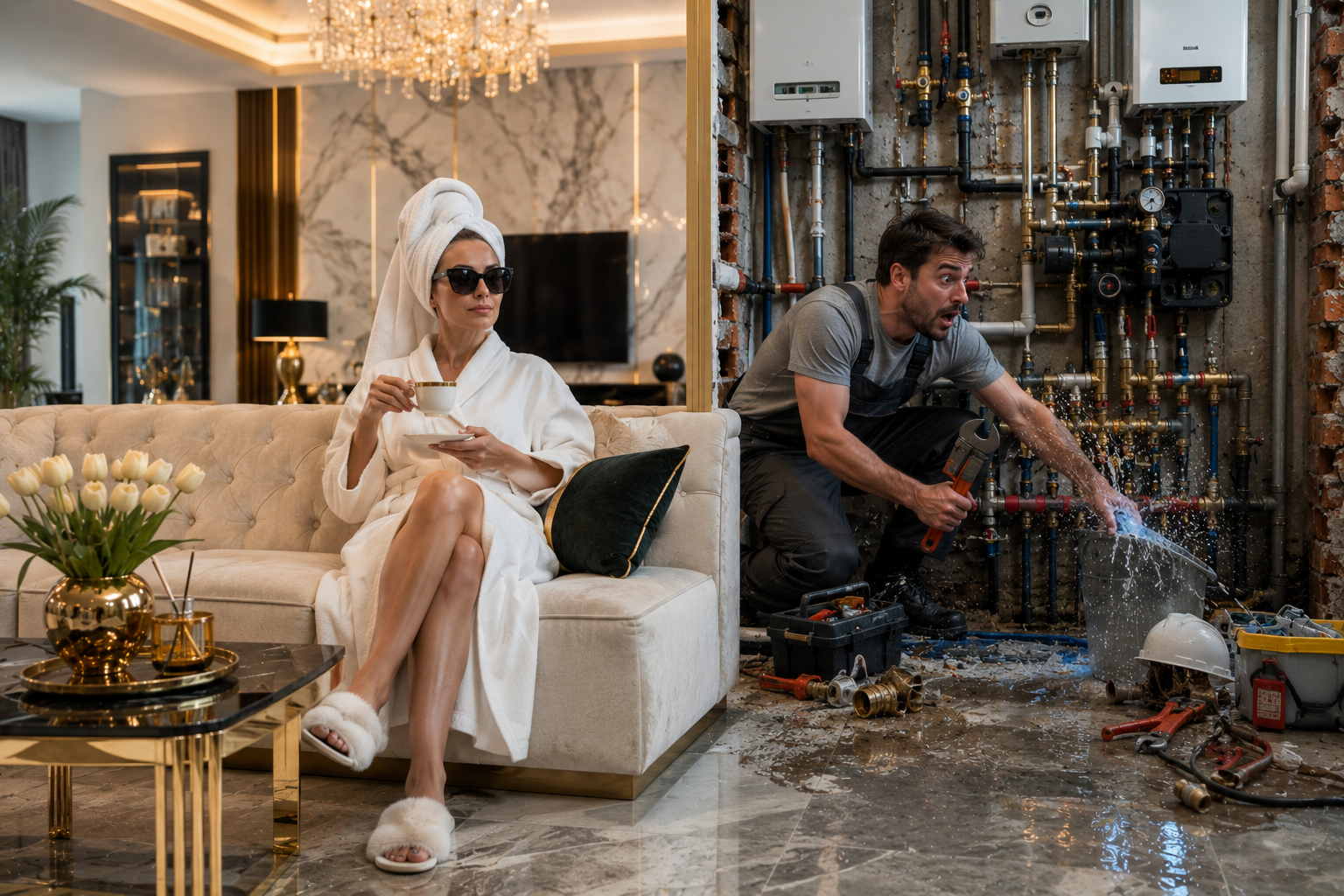

The optical illusion of the “magazine living room” and the reality of the home fridge
There’s a modern illness that hits anyone who decides to renovate their home. It’s called “rendering syndrome.” The patient spends hours scrolling Instagram and Pinterest feeds. They fall in love with grey resin floors, matte black taps, and concrete-effect walls. Then they move into the home of their dreams. And after three days, they start to hate it. Why? Because the resin floor is icy. The matte black tap stains just by looking at it. The concrete-effect wall has a damp patch that looks like the map of New Zealand.
We’ve confused aesthetics with luxury. We’ve mistaken visual beauty—the kind made for social photos—for real living comfort. True luxury, in 2026, isn’t Calacatta marble. True luxury is not hearing the upstairs neighbour when they walk. It’s breathing clean air without having to open windows into traffic. It’s having an even temperature in every room, with no blasts of icy air. A beautiful house that doesn’t work is just an expensive set for a horror film. Today we’ll explain why real wealth hides inside the walls, not on the surface.
Thermal comfort: why the thermostat is a serial liar
Let’s start with warmth—or rather, the feeling of warmth. The average homeowner has an almost mystical relationship with the thermostat. They set it to twenty-one degrees. If they’re cold, they raise it to twenty-two. If they’re still cold, they raise it to twenty-three. The thermostat, lucky it, shows twenty-three degrees. But you keep shivering. Why? Because the thermostat measures air temperature. But the human body doesn’t exchange heat with the air. The human body exchanges heat with surfaces.
This is called “mean radiant temperature.” If your walls are cold because there’s no insulation, your body radiates heat toward the walls. You’ll feel frozen, even if the air is at twenty-three degrees. It’s physics, not a whim. The UNI EN ISO 7730 standard, which defines thermal comfort, says it clearly: wellbeing depends on the balance between air temperature and surface temperature.
True thermal luxury is a radiant panel system in the floor or walls. Surfaces are gently warm. The body doesn’t lose heat. The feeling is immediate comfort. No drafts are needed. No noise is needed. Heat is uniform, from head to toe. If you’re renovating and think you’ll keep the old cast-iron radiators because “they’re vintage,” you’re choosing to live in a home with different microclimates in every room. Luxury is uniformity.
Air quality: breathing without slowly poisoning yourself
We breathe. About twenty thousand times a day. We spend ninety percent of our time indoors. And yet, when we think about renovation, we worry about tile colour. We don’t worry about what we breathe. That’s a huge mistake.
Modern homes are insulated. They’re sealed. They’re perfect thermoses. The problem is that thermoses don’t breathe. A family of four produces about twelve litres of water vapour per day. Between showers, cooking, and breathing. If that vapour doesn’t get out, it stays inside. Relative humidity shoots up. Mold arrives. But it’s not just humidity. There’s CO2. The carbon dioxide we exhale. In a closed bedroom at night, CO2 levels exceed 1500 ppm in a few hours. The result? You wake up tired. You have a headache. You’re irritable.
The solution isn’t opening windows at random. Especially if you live in the city and outside there’s smog or pollen. The solution is MVHR—Mechanical Ventilation with Heat Recovery. The UNI 10339 standard sets the air-change rates needed for health. An MVHR system extracts stale, humid air. It supplies fresh, filtered air. It recovers heat so energy isn’t wasted. True luxury is opening your eyes in the morning and breathing mountain air, without having opened a single window.
Acoustic comfort: silence worth more than gold
Noise is an invisible pollutant. It raises cortisol. It increases blood pressure. It makes us irritable. And yet, sound insulation is the great forgotten element of Italian renovations. Everyone wants parquet. Nobody wants a floating screed.
The DPCM of 5 December 1997 sets the passive acoustic requirements for buildings. Impact noise must be below 65 decibels. But that’s the bare minimum law. Real comfort requires much higher standards. If you hear the upstairs neighbour walking—or worse, dragging a chair—your floor slab isn’t insulated.
Impact noise must be tackled at the source. Before laying the floor. You need a floating screed. You need a high-quality resilient layer, like high-density rock wool or cross-linked polyethylene. This layer decouples the floor from the structure. Footsteps don’t transmit. Silence rules again.
And let’s not forget the systems. Rigid PVC drain pipes are megaphones. When the neighbour flushes, you hear it. The solution is to use sound-absorbing polypropylene pipes. Or wrap the stacks with mineral-wool shells. True luxury is never knowing when the neighbour goes to the bathroom.
Lighting: seeing without feeling like you’re in an operating room
Light is essential. It regulates our circadian rhythm. It affects our mood. But the average approach to home lighting is a disaster. People choose the designer chandelier. They buy random bulbs at the supermarket. The result is a home that looks like an operating room or a nightclub.
The classic mistake is colour temperature. People install cool 6000 Kelvin lights in the living room and bedroom. The brain gets a blue stimulus. It thinks it’s noon. It blocks melatonin. You don’t sleep. Or you sleep badly. In the evening you need warm light, under 3000 Kelvin.
Then there’s CRI, the Colour Rendering Index. It indicates how natural colours look under that light. A low CRI makes food look unappetising. It makes skin look dull. For real visual comfort, CRI must be above 90.
And then there’s glare. Direct light in your eyes is annoying. It causes fatigue. Light must be diffused. Indirect. Designing lighting means studying reflections, shadows, and biological needs. True luxury is light that makes you feel good, not light that hurts your eyes.
Hidden systems: the veins and nerves of the home
Systems are the circulatory and nervous system of the home. They’re invisible. But they’re essential. Bad plumbing will flood your home. Bad electrics will burn your home down.
For plumbing, old galvanized iron pipes are a sentence. They corrode. They clog. Water pressure collapses. Today, multilayer or PPR pipes are used. PPR is heat-welded. It becomes one single piece. It doesn’t leak. It doesn’t corrode. It lasts fifty years.
For electrics, the CEI 64-8 standard is the bible. It’s not enough that the light turns on. You need protections. You need an RCD. You need grounding. You need dedicated lines for major appliances. And today, you need provision for home automation and EV charging.
DM 37/08 requires companies to issue the Declaration of Conformity. Without that piece of paper, the system doesn’t exist. True luxury is safety. It’s knowing the walls don’t hide ticking time bombs.
Why Italy isn’t one single block
Italy is a wonderful country. But it’s a nightmare for anyone trying to standardise solutions. The GEO factor—geography—changes everything. You can’t renovate the same way in Milan and in Palermo.
In the Po Valley, the enemy is winter humidity and fog. You need breathable insulation. You need a powerful MVHR system to prevent mold. You need radiant heating to fight perceived dampness.
In the South and on the Islands, the enemy is the summer sun. You need thermal mass. You need external solar shading. You need phase-shifted insulation to delay heat entering. MVHR helps with night cooling.
In coastal areas, salt air corrodes everything. You need aluminium frames with marine treatments. You need outdoor heat-pump units with epoxy coatings.
In historic centres, landscape constraints block external insulation. You need internal insulation, but with breathable materials like calcium silicate. You need maximum attention to thermal bridges.
Ignoring the GEO factor means designing a home that fights its environment. True luxury is a home that works with its climate.
Energy efficiency: the luxury of not paying astronomical bills
There’s a luxury you can’t see, but you feel it every time the bill arrives. It’s energy efficiency. A beautiful but leaky home is a money drain. An efficient home is an investment.
The envelope must be insulated. Thermal bridges must be eliminated. Windows must have thermal breaks, low-e glazing, and Argon gas.
The heat generator must be efficient. Heat pumps have replaced gas boilers. They have high COP and SCOP. For every kilowatt-hour of electricity, they produce three or four kilowatt-hours of heat. If you pair the heat pump with photovoltaics and a storage system, the gas bill drops to zero. And the electricity bill is wiped out for much of the year.
True luxury is energy independence. It’s not having to check the gas price on the evening news. It’s knowing your home produces the energy it consumes.
Home automation: intelligence you don’t see
Home automation isn’t turning on the light with your phone. That’s convenience. True luxury is automation that works without you noticing.
It’s the system that lowers shutters when the sun hits hard. It’s the system that turns on MVHR when CO2 rises. It’s the system that manages loads to maximise self-consumption from photovoltaics.
Automation should be wired. Wireless protocols are fragile. Wired KNX or Matter guarantees reliability. True luxury is a home that thinks for you, not a home that forces you to download fifteen different apps.
Beauty that lasts
Ultimately, aesthetic beauty is fleeting. Colours go out of fashion. Materials wear out. But thermal and acoustic comfort, and air quality, remain.
At Gruppo Impianti Ristrutturazioni, we don’t sell aesthetics alone. We design ecosystems. We know true luxury is invisible. It’s the feeling of wellbeing you get when you walk into your home. It’s silence. It’s clean air. It’s the perfect temperature.
Don’t build a box. Build an organism. A home that works well is the only truly beautiful home.
FAQ: The questions spinning in your head (and the answers that will save your life)
I have a beautiful open space, but when I cook the smell spreads everywhere. Is there a solution without rebuilding walls?
Yes, but it requires a targeted intervention. The problem is that stale air isn’t extracted fast enough. The first thing to check is the hood: it must be ducted (not just recirculating) and with a flow rate suited to the room volume. If the hood is already powerful, the issue is the lack of make-up air. The solution is installing a decentralised wall MVHR unit, which ensures constant, filtered air exchange.
Mold in the corner of the new bedroom—is it my fault for not airing enough, or a construction mistake?
In 90% of cases in new or renovated homes, it’s a construction mistake: a thermal bridge. If mold appears locally, especially in external corners, it means the surface temperature there is too low and moisture condenses. Airing helps, but it doesn’t solve the physical cause. The definitive solution is to intervene to break the thermal bridge and raise the wall’s surface temperature.
Can I use the same materials and the same type of insulation for a seaside home and a mountain home?
Absolutely not. The GEO factor is decisive. By the sea, the priority is resistance to salt corrosion and managing summer cooling. In the mountains, the priority is airtightness, high-resistance winter thermal insulation, and managing snow loads. Using a wall build-up designed for a Mediterranean climate at high altitude will lead to interstitial condensation problems.
My architect designed an internal bathroom with no window, saying a little fan is enough. Can I trust that?
It depends on what they mean by “little fan.” If it’s the classic spot bathroom extractor, the answer is no, it’s not enough. A windowless bathroom requires a much higher air-change rate. The professionally sound solution is to integrate that bathroom into a centralised Mechanical Ventilation with Heat Recovery (MVHR) system, with dedicated extract ducts and a correctly sized airflow rate.
I want to soundproof the home cinema room. Should I use pyramid panels or rock wool?
You should use both, but for different purposes. To isolate the room and keep sound from escaping, you need to build a “room within a room” using the mass-spring-mass system. Use double plasterboard walls with a cavity filled with high-density rock wool. Once the room is isolated, use acoustic absorption panels to control internal reverberation and improve sound quality. Sound insulation and sound absorption are two different things.
Are Italian acoustic regulations really respected in new buildings?
Unfortunately, the 1997 DPCM is often ignored or applied at the bare minimum. Many builders use cheap solutions that meet the letter of the law, but not the spirit of comfort. That’s why, in a renovation, don’t trust the existing condition. Check, test, and, if necessary, rebuild the acoustic assemblies with high-quality materials.
Stop building boxes, start designing ecosystems
You’ve read this far and you’ve understood that the difference between a home that works and one that’s just a nice empty shell lies entirely in design details. Are you tired of seeing gorgeous homes in magazines that, in real life, are cold, noisy, and full of drafts? It’s time to raise the bar.
Contact Gruppo Impianti Ristrutturazioni today. We don’t just lay pipes and cables. We work with architects and technicians to ensure every aesthetic choice is backed by a solid mechanical, thermal, and acoustic foundation. Book a technical consultation for your project. We’ll analyse orientation, local climate, materials, and airflow to make sure your home is truly a wellbeing refuge. Don’t settle for a rendering. Demand the reality of comfort. Write to us, call us, or come and see us.
Let’s build the future, without the mistakes of the past.