
The drama of the cold wall and the thermostat illusion
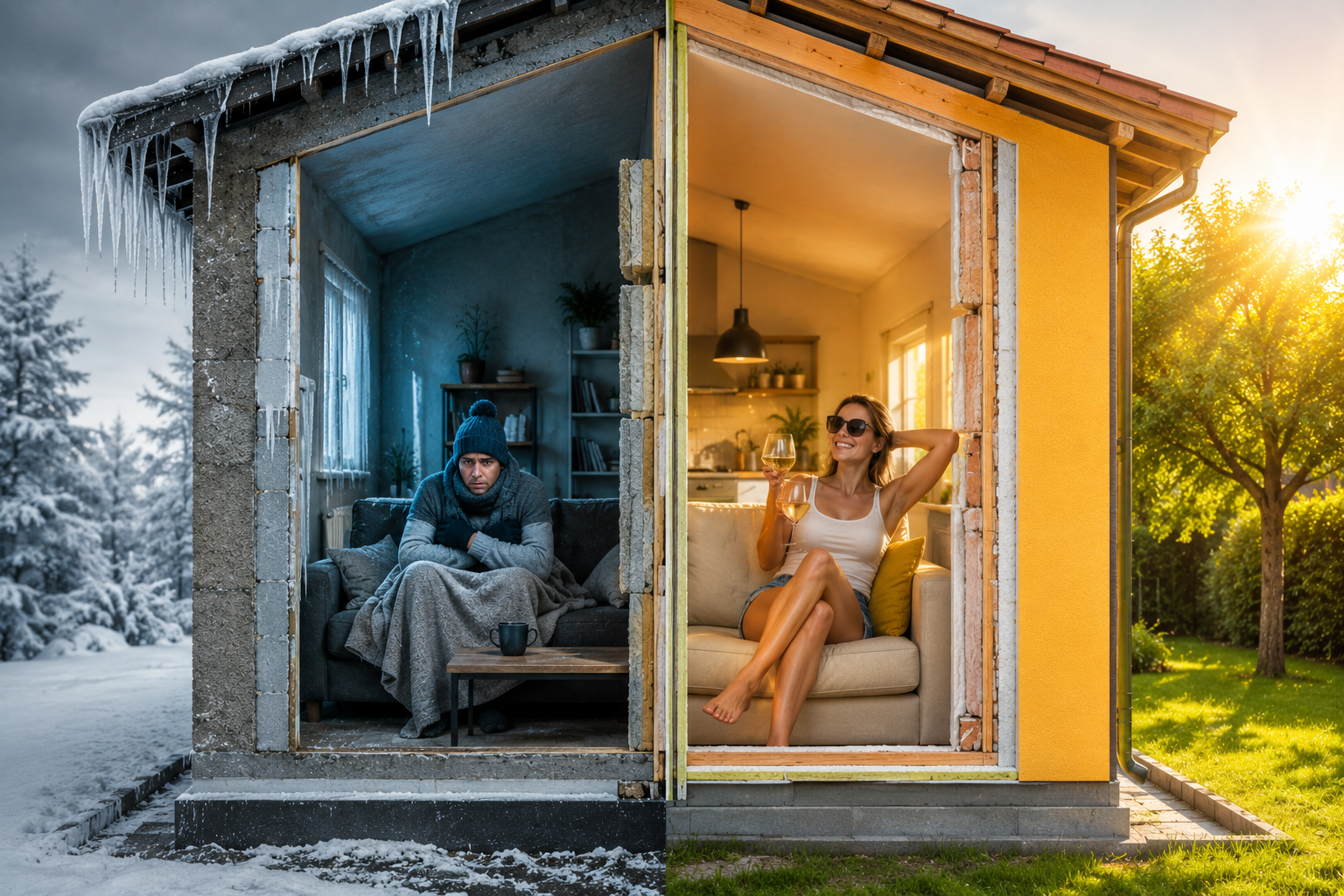
There’s a winter ritual shared by millions of Italians. It usually happens in the evening, after dinner. You walk up to the living room’s exterior wall to hang a picture or simply to rest your hand on it. The contact is shocking. The wall is icy. It feels like touching the surface of an iceberg. At that exact moment, the thermostat reads twenty-one degrees. But you feel cold. Why? Because the human body doesn’t read thermometers. The human body exchanges heat with surfaces. If the walls are cold, your body radiates heat toward them. You feel frozen, even if the air is lukewarm.
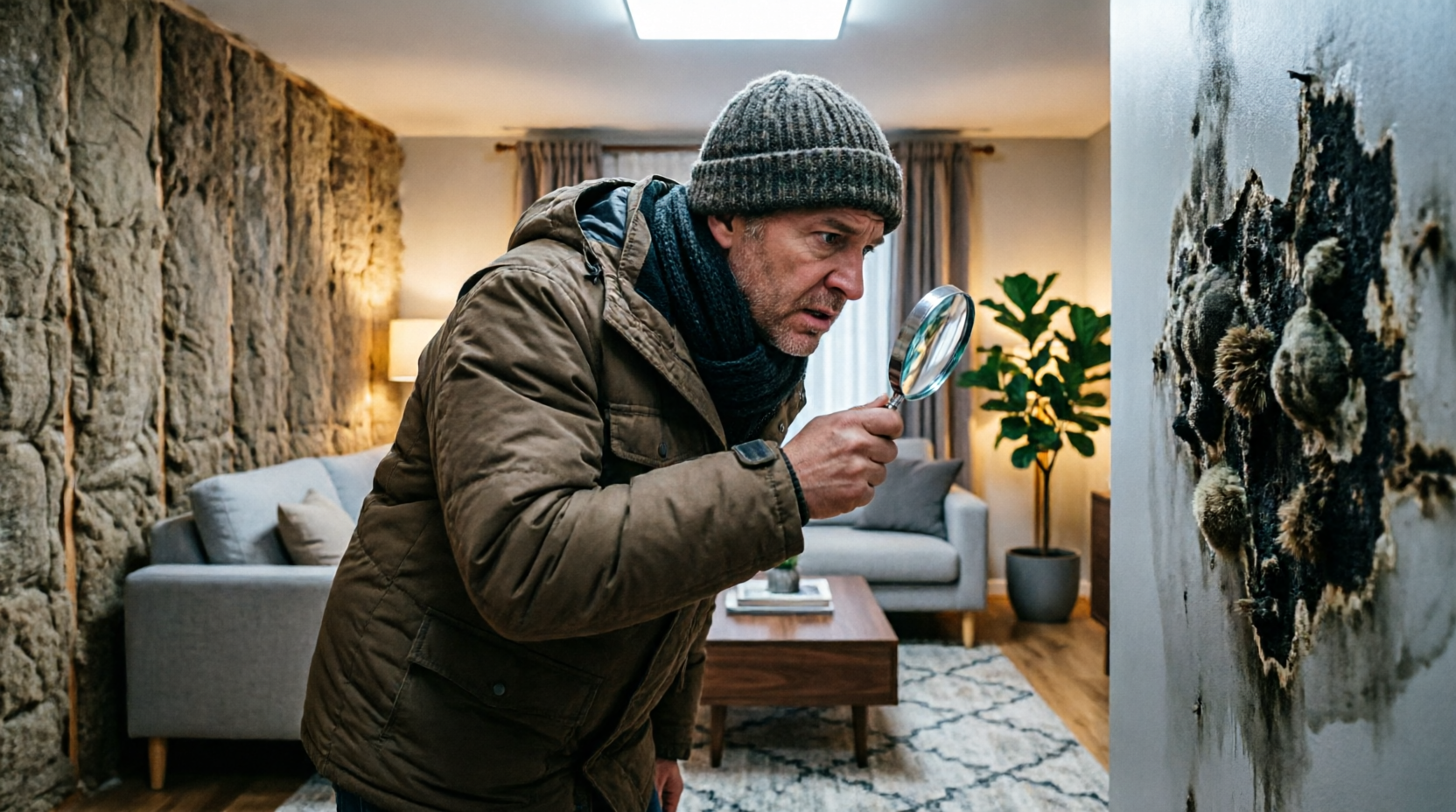
Then spring arrives. Or worse, autumn. You notice a dark halo in the corner of the bedroom. At first you think it’s dirt. Then you realize it’s mold. Black, damp mold, with that cellar smell. And right then, the dilemma is born. Your home isn’t insulated. Or it’s insulated badly. And now you have to decide how to act. The choice boils down to two roads: external thermal insulation (cappotto) or internal thermal insulation. It seems like a simple choice. In reality, it’s a minefield of physics, red tape, costs, and risks. Today we’ll guide you through this maze. With irony, but above all with the hard technical truth.
External insulation (ETICS): the undisputed king (but with condo problems)
Let’s start with the ideal solution. External thermal insulation, technically called ETICS (External Thermal Insulation Composite System). It’s the undisputed king of energy efficiency. Why? Because it wraps the whole building like a winter down jacket. It eliminates thermal bridges. It protects the structure from temperature swings. It keeps interior walls warm, using their thermal mass to stabilize temperature.
The advantages are huge. You don’t lose usable floor area. You don’t have to empty rooms during the works. Efficiency is maximal. But there’s a huge “but”. And this “but” has a name: shared ownership. If you live in a condominium, the façade is a common part. To do external insulation you need a favorable vote from the majority of the condo owners. And here the Greek tragedy begins. There will always be Mr. Rossi on the third floor who refuses to pay because “he’s not cold”. There will be Mrs. Bianchi who wants a white finish, while the building wants gray.
And if you live in a historic center? In Rome, Florence, Bologna, or Palermo, the façade is protected. The Fine Arts authority will never allow you to glue ten centimeters of polystyrene onto an 18th‑century building. In these cases, external insulation is an unachievable dream. And that’s where the alternative comes in.
Internal insulation: the misunderstood hero or a disaster waiting to happen?
Internal thermal insulation is often seen as the poor cousin of external insulation. It’s chosen out of necessity. You do it when you can’t touch the façade. You do it when renovating a single apartment in a condominium. You do it when you want to insulate only one cold room.
But internal insulation hides terrible pitfalls. The biggest is loss of space. Putting five or ten centimeters of insulation on all perimeter walls means losing precious square meters. In a small apartment, it can mean losing the footprint of an entire wardrobe.
But the real problem isn’t space. It’s physics. When you insulate from the inside, you move the “dew point” into the masonry. If you don’t design the insulation build-up in a maniacally precise way, the water vapor produced at home (cooking, showering, breathing) passes through the insulation, hits the cold wall, and condenses. Result? Hidden mold behind the insulation. Plaster decay. Structural damage. Internal insulation doesn’t forgive mistakes. It requires perfect design.
Physics isn’t an opinion: dew point and vapor
To understand the difference, we have to talk about vapor. Warm air holds more moisture than cold air. In winter, indoor air is warm and humid. Outdoor air is cold and dry. Vapor always tries to escape outward, passing through walls.
With external insulation, the wall stays warm. Vapor passes through the masonry and the insulation without ever cooling enough to condense. Everything works.
With internal insulation, the structural wall stays cold. The insulation is warm. When vapor crosses the insulation and touches the cold wall, it turns into water. That’s the dew point. If the water can’t dry out, mold is born.
To avoid this disaster, internal insulation requires specific materials. “Hygroscopic” and “capillary-active” materials. They must be able to absorb moisture and redistribute it. Or they require a perfect, airtight vapor barrier on the interior side. But if the vapor barrier breaks at even one point (a nail for a picture, an electrical outlet), moisture gets in and never gets out. It’s a trap.
The GEO factor: geography dictates choices
Here we get to the heart of the matter. Italy isn’t a single block. Climate changes drastically from north to south. And the choice between internal and external depends on your geographic location. This is crucial for energy performance and for your indoor health.
If you live in the Po Valley (Milan, Turin, Bologna), the enemy is winter humidity and fog. Internal insulation is extremely risky. Relative humidity is often close to 90%. If you insulate from the inside without strong Mechanical Ventilation with Heat Recovery (MVHR), mold is guaranteed. Here external insulation is almost mandatory for the building’s health.
If you renovate in a Historic Center (central Rome, Florence, Siena), landscape restrictions force you into internal insulation. But you can’t use polystyrene. You must use breathable materials, like calcium silicate or wood fiber. Materials that let the historic wall “breathe”.
If you live in a Coastal Area (Genoa, Rimini, Naples), salt spray and marine humidity attack façades. External insulation must have a specific finish, acid-resistant and salt-resistant. Internal insulation is less exposed to these attacks, but it must fight rising damp if you’re on the ground floor.
If you live in the Mountains (Cortina, Livigno, Aosta Valley), temperatures drop to minus fifteen degrees. Insulation thickness must be significant. Internal insulation is not recommended here, because the outer wall freezes completely. You need external insulation to protect the structure from freeze–thaw cycles, which crack bricks.
Materials: it’s not all rock wool
Choosing the wrong material is the fastest way to throw money away. For external insulation, expanded polystyrene (EPS) or rock wool are excellent standards. They cost the right amount, insulate well, and are durable.
For internal insulation, EPS is a disaster. It’s impermeable. It traps moisture. Using polystyrene indoors is a crime against building practice.
The right materials for the inside are different.
Calcium silicate is the king of internal insulation. It’s alkaline. That means it has a high pH. Mold can’t grow on an alkaline material. It’s capillary-active, it absorbs and releases moisture. It’s perfect for historic centers.
High-density wood fiber is excellent. It has great “phase shift”. That means it delays summer heat entering. It keeps the home cool in summer and warm in winter.
Natural cork is fantastic, breathable and mold-resistant. But it costs a lot.
Aerogel is the future. It’s a nanostructured material, extremely expensive, but with two centimeters it insulates like ten of polystyrene. It’s used when you can’t afford to lose even a millimeter of space.
Bureaucracy and bonuses: sweet pain
Let’s talk money. The Italian state incentivizes thermal insulation. But the rules change continuously. In 2024 and 2025, the 110% Superbonus is a distant memory for most private owners.
Today people talk about the 65% Ecobonus for energy retrofits, or the 50% Renovation Bonus. To access the Ecobonus, the intervention must improve the building’s energy performance by at least two energy classes, or reach class A4.
Attention: for works on single housing units, bonuses are often tied to replacing the winter heating system (the boiler or the heat pump). This is called a “driving intervention”. If you do only the insulation without touching the boiler, you often lose access to the higher deductions.
Also required: the energy performance certificate (APE) before and after the works. A sworn technical report by a qualified professional. Submission to ENEA. Bureaucracy is a three-headed monster. If you get one code wrong, you lose 65% of the expense. Relying on a structured company and a serious HVAC/energy engineer isn’t optional. It’s the only way out.
Hidden costs and the real return on investment
How much does insulation cost? External insulation costs between 100 and 150 euros per square meter of façade, but you must add scaffolding costs, which in cities like Milan or Rome can double the price due to public land occupation fees.
Internal insulation costs between 50 and 90 euros per square meter of wall. It seems cheaper. But you must factor in the loss of value of usable floor area. And you must factor in finishing costs: you have to redo plaster, skim coats, paint, and move electrical outlets and radiators.
The real return on investment (ROI) isn’t only in the tax deduction. It’s in bill savings. A well-insulated home uses up to 40–50% less for heating. It’s in comfort. You won’t have mold anymore. You won’t have cold walls anymore. It’s in market value. A home in energy class A or B sells faster and at a higher price than a home in class G.
The choice isn’t aesthetic, it’s survival
Ultimately, the choice between internal and external insulation isn’t based on magazine colors. It’s based on physics, geography, and the law.
External insulation is the best solution overall. If you can do it, do it. Overcome condo resistance. Fight with the heritage authority. It’s worth it.
If you can’t, internal insulation is the only way. But don’t improvise. Don’t use polystyrene. Use breathable materials. Install MVHR. Rely on professionals who can calculate the dew point.
Your home is your shelter. Not turning it into a mold gas chamber or a fridge in winter is the bare minimum.
FAQ: The questions spinning in your head (and the answers that will save your wallet)
Can I do internal insulation only in the cold bedroom, or do I have to do it on all the walls?
Doing internal insulation on just one wall is a serious conceptual mistake. If you insulate only one wall, the other three stay cold. Water vapor will move toward the cold, uninsulated walls, creating mold in completely new corners. Also, huge thermal bridges form where the insulated wall meets the uninsulated ones. Internal insulation must be continuous. If you do it, do it on all perimeter walls, or at least on those facing north and west, closing the thermal perimeter.
Is calcium silicate really that miraculous for internal insulation?
Yes, but with some clarifications. Calcium silicate is a mineral material, highly alkaline (pH around 11–12). Mold can’t survive in such a basic environment. It’s also capillary-active: it absorbs excess moisture and releases it when the air is dry. This prevents surface condensation. However, its insulating power is slightly lower than polystyrene or wood fiber. To achieve the same thermal transmittance, you need slightly greater thicknesses. But for building health and mold prevention, it’s unbeatable.
If I do internal insulation, do I absolutely have to install MVHR (Mechanical Ventilation with Heat Recovery)?
It’s not “mandatory” by law in all cases, but it’s strongly, warmly, desperately recommended. Internal insulation reduces wall breathability. The moisture produced at home (showers, cooking, breathing) stays trapped. Without constant mechanical air exchange, relative humidity shoots through the roof. MVHR isn’t a luxury. In a home insulated from the inside, it’s the only way to ensure healthy air and prevent condensation. Consider it an integral part of the insulation package.
Does the 50% Renovation Bonus also cover internal insulation?
Yes, thermal insulation of opaque vertical surfaces (walls) is included among extraordinary maintenance and energy retrofit works eligible for the 50% Renovation Bonus (with a spending cap of 96,000 euros per housing unit). However, to access the deduction, the intervention must meet the thermal transmittance requirements set by the Minimum Requirements Decree and the regulations in force in your climate zone. You must submit the ENEA file within 90 days of the end of the works. Attention: tax rules change often. Always check with an accountant or a qualified technician the rules in force when the works begin.
How much space do I really lose with a high-quality internal insulation system?
It depends on the material and the climate zone. To meet legal limits on thermal transmittance (U) in cold areas (like the Po Valley), you may need 10–12 cm of wood fiber or calcium silicate. This means losing about 10–12 cm on each perimeter wall. In a 4x4 meter room, you lose about 1.5–2 square meters of usable floor area. If you use high-performance materials like aerogel or vacuum insulation panels (VIP), you can go down to 3–5 cm, losing much less space, but costs rise exponentially.
I heard external insulation “suffocates” the house and causes mold. Is it true?
It’s an urban legend born from improper material use in the 1990s. If external insulation is designed correctly, with breathable materials (like rock wool or EPS with breathable additives) and siloxane or silicate finishes, the house “breathes” perfectly. Water vapor exits from inside, passes through the wall and insulation, and disperses into the outdoor air. Mold appears only if impermeable materials are used (like certain resins or plastics) or if thermal bridges aren’t resolved. A properly executed external insulation system eliminates mold; it doesn’t create it.
Stop shivering and start insulating
You’ve read this far and you’ve understood that thermal insulation isn’t a puzzle game. It’s a complex science, made of physics, materials, and geography. Are you tired of paying gas bills that look like 1990s phone bills? Are you tired of scraping off mold with bleach every autumn? It’s time to act methodically.
Contact Gruppo Impianti ristrutturazioni today. Book an energy assessment and a technical site inspection. Our energy engineers will analyze your home, evaluate geographic and bureaucratic constraints, and propose the perfect insulation solution for your specific case. Whether it’s external rock-wool insulation or internal calcium-silicate insulation, we’ll guarantee a watertight, certified project ready to access tax deductions. Don’t leave your home’s comfort to chance. Write to us, call us, or come visit us. Let’s turn your home into a perfect thermos.