
The nightmare of fifteen apps and the crazy-remote syndrome
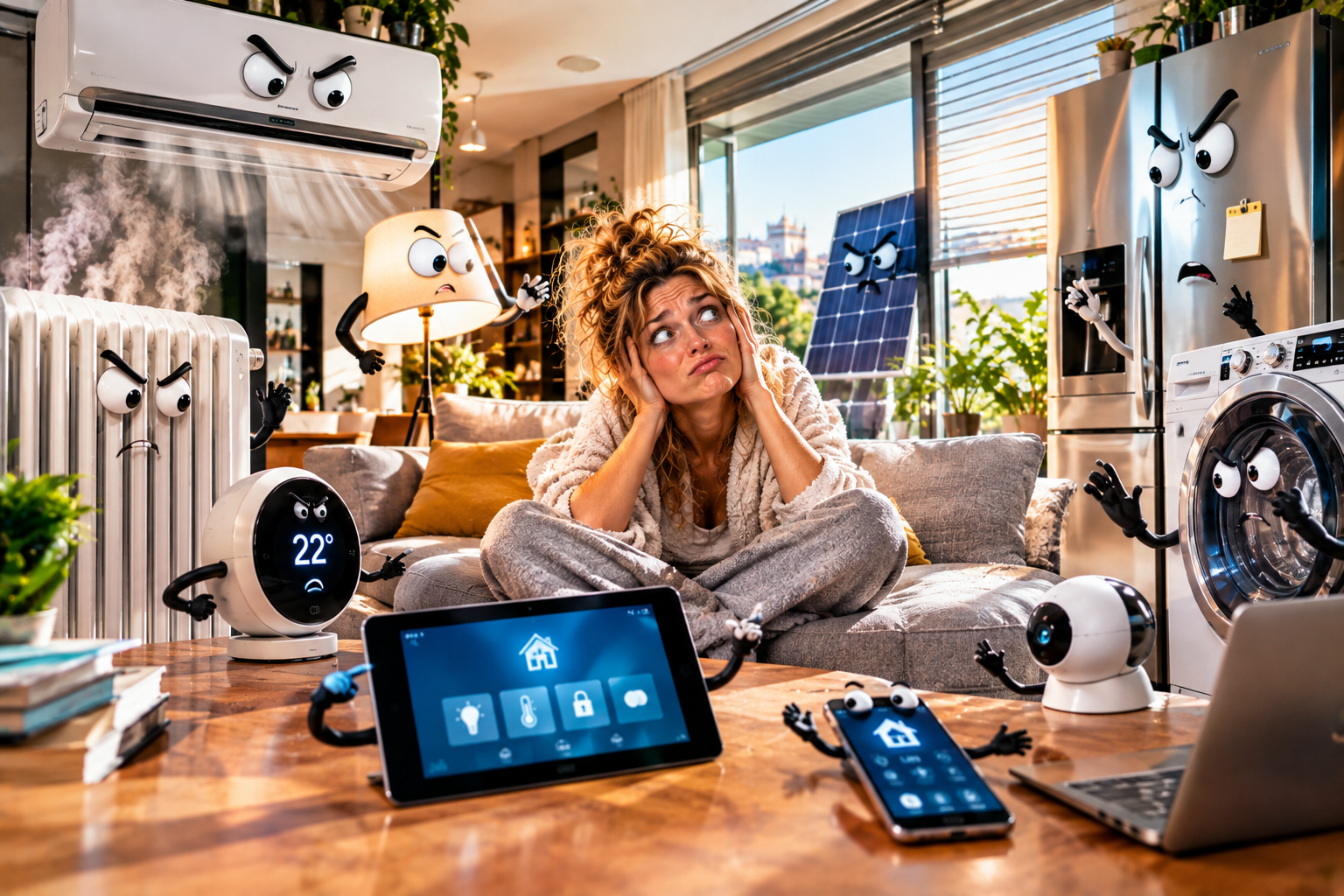
Picture this scene. It’s Sunday morning. You want to enjoy the sun, lower the shutters halfway, and play a relaxing playlist in the background. What do you do? You pull out your phone. You open the shutter automation system app. You wait for it to connect to the cloud. It fails. You reopen the app. It works. You lower the shutters. Then you open the HVAC app to raise the temperature by one degree. Then you open the lights app to set the “Relax” scene. Then you open the photovoltaic system app to check production. In the end, by the time you’ve finished managing your “smart home,” the sun has set, the playlist is over, and you’ve got a headache.
This isn’t a smart home. This is a schizophrenic home. The market sold us the idea that home automation means piling up Wi‑Fi gadgets and controlling everything remotely. But having fifteen different remotes doesn’t make you Iron Man. It makes you a slave to technology. The real revolution isn’t remote control. The real revolution is integration. It’s making systems talk to each other. It’s creating a single brain that handles complexity for you. Today we’ll explain why making heating talk to shutters, and lights talk to the alarm, isn’t a rich-person whim, but the only way to get true comfort and real energy savings.
What “integration” really means (spoiler: it’s not putting everything on Wi‑Fi)
There’s a huge difference—often ignored by supermarket gadget sellers—between automation and integration. Automation is when you press a button and something happens. Integration is when the system knows what must happen without you pressing anything.
Let’s make a practical example. Automation is having a smart thermostat that lets you turn on the heating from your phone while you’re at the café. Integration is the system that, cross-checking data from the local weather station, the indoor temperature read by sensors, and the presence of people at home, decides to run the heat pump at 30% power because it knows you’ll arrive in an hour and the house will already be at the perfect temperature, without wasting energy.
Integration requires devices not to be happy little islands. They must share data. The rooftop brightness sensor must talk to the shutter motor. The energy meter in the electrical panel must talk to the car charging station. If every system has its own closed protocol, its own proprietary cloud, and its own dedicated app, you don’t have an integrated system. You have a Frankenstein of devices that, sooner or later, will stop communicating when the manufacturer decides to shut down the servers.
The single brain: the BMS and the end of system anarchy
To make systems talk, you need a translator. Better yet, you need a conductor. In technical terms, this is called a BMS (Building Management System) or, in advanced residential settings, a Home Controller or Home Automation Server.
A BMS isn’t a simple computer. It’s rugged hardware, often installed in the electrical panel, running real-time operating systems. It doesn’t rely on the cloud for vital functions. If the internet goes down, your BMS keeps managing the home perfectly. The cloud is only for remote smartphone control, but the logic, scenes, and automations live locally.
This single brain collects data from all subsystems. It receives input from presence sensors, window-opening sensors, temperature probes, and energy meters. It processes this data according to programmed logic and sends commands to actuators. This centralization changes everything. It enables cross-system logic that no single system could ever manage on its own.
The thermodynamic dance: when HVAC talks to shading
Let’s get into the technical teaching. Heating and cooling are the biggest slice of the energy bill. Managing them in isolation is a major mistake. Integration between the HVAC system (Heating, Ventilation, and Air Conditioning) and solar shading is the first big step toward real efficiency.
Physics teaches us that summer sun is our worst enemy. Once solar rays pass through the glass and hit the floor, the heat is in. The air conditioner will have to work at full blast to expel it, consuming a huge amount of energy. An integrated system doesn’t wait for the room to get hot. Outdoor irradiance sensors tell the BMS the sun’s intensity. The BMS, knowing the orientation of the windows, commands shutters or louvers to lower before the sun hits the glass.
But the magic happens in winter. The BMS knows winter sun is low and free. If the indoor temperature is below the setpoint, the system keeps shading open to exploit passive solar gain, reducing the heat pump’s workload. This continuous dialogue between envelope (shading) and system (HVAC) can cut thermal consumption by up to 30%. No isolated smart thermostat can ever do that.
Lighting that doesn’t give you a migraine: light, presence, and scenes
Integrated lighting goes far beyond simple “on and off.” We’re talking about managing natural and artificial light in symbiosis. Imagine working in your studio. Sunlight changes throughout the day. An integrated system uses built-in brightness sensors (lux meters) recessed into the ceiling. They constantly measure the natural light reaching the desk.
If the sun is strong, the system automatically lowers the intensity of LED artificial lights, keeping a constant illumination level (this technique is called Daylight Harvesting). If the sky clouds over, the lights rise imperceptibly. The result is perfect visual comfort and steady electrical savings.
Moreover, integration allows dynamic control of color temperature (Human Centric Lighting). In the morning, lights are cool and bright to stimulate cortisol. In the evening, the system, cross-checking time and presence, automatically shifts lights to warm, soft tones to support melatonin production. It’s not magic. It’s programming complex scenarios that require a robust communication bus, like DALI for lighting, integrated into the main system.
The Energy Management System (EMS): the invisible accountant that saves your bill
Here we touch the most critical point for your wallet. If you have a photovoltaic system, a storage battery, a heat pump, and an electric car, you have four systems at home that absolutely must talk to each other. Otherwise, you’ll waste money.
The EMS (Energy Management System) is the BMS module dedicated to managing energy flows. Its goal is to maximize self-consumption. PV produces energy at noon. If nobody is home, the energy is fed into the grid and paid just a few cents. In the evening, when you return, you turn everything on and draw energy from the grid at full price.
The EMS solves this mismatch. It monitors production and consumption in real time. If it detects a surplus of PV production, it automatically activates deferrable loads. It turns on the heat pump to heat domestic hot water in the storage tank. It starts the washing machine. Or, if you have an EV, it modulates charging to absorb exactly the excess energy, without drawing from the grid.
If production drops because a cloud passes by, the EMS temporarily disconnects non-critical loads (load shedding) to avoid draining the storage battery too quickly. This active, reactive management is impossible without an integrated system. It turns the home from a simple consumer into an optimized micro power plant.
Safety and prevention: when water calls the electrician
Integration isn’t only for comfort and savings. It protects your assets. Think about a water leak. In a traditional system, the flood sensor triggers a siren. And then? The water keeps flowing, soaking the screed and the downstairs neighbor.
In an integrated system, the flood sensor sends a signal to the BMS. The BMS, in a fraction of a second, commands the motorized solenoid valve installed upstream of the plumbing system to close. The water stops. But it doesn’t end there. The BMS can also command the HVAC system to shut down (to prevent water from entering vents) and send a push notification to your phone, attaching the security camera video to check what happened.
The same applies to fire safety or gas detection. If the smoke sensor detects an incipient fire, the integrated system can automatically unlock security doors to facilitate escape, shut down the ventilation system to avoid feeding the flames, and turn all lights to 100% to illuminate escape routes. These cross-logic routines save lives and protect the home.
The protocol jungle: KNX, Matter, Zigbee, and the standards war
To make devices from different brands talk, you need a common language. Here we enter the technical ground where the real reliability game is played. There are two big families of protocols: wired and wireless.
The undisputed king of professional wired systems is KNX. It’s an open global standard. It belongs to no brand. It uses a dedicated cable (two-wire bus) that carries both data and a small power supply. KNX devices are decentralized: if the central server breaks, switches and actuators keep working according to stored logic. It’s robust, fast, immune to interference, and lasts decades. It’s the mandatory choice for critical functions (HVAC, lighting, security, energy management).
The wireless world exploded with protocols like Zigbee, Z-Wave and, more recently, Matter. Matter is the big 2024/2025 dream: an IP-based protocol that promises to make everything talk to everything, from the fridge to the light bulb, overcoming manufacturers’ walled gardens. It’s great for integrating consumer devices and gadgets. However, wireless has unavoidable physical limits: bandwidth, latency, and susceptibility to interference.
The correct teaching choice isn’t “either one or the other.” It’s hybrid. A solid architecture provides a wired backbone (KNX or Ethernet) for fixed, critical infrastructure, and a wireless layer (Zigbee/Matter) for flexible addition of sensors, portable devices, or retrofit where cables can’t be run. Relying 100% on home Wi‑Fi for home automation is the number-one mistake that leads to malfunction of the entire system.
The “DIY” myth and the reality of the System Integrator
There’s a dangerous trend to think integrated home automation is within everyone’s reach, thanks to YouTube tutorials and “plug and play” kits. The truth is that designing an integrated system requires multidisciplinary skills.
A System Integrator is not an electrician. Not an IT technician. It’s a hybrid role that knows thermodynamics, electrical engineering, computer networks, and logic programming. They must know how to size a KNX bus. They must know how to configure a router to create a VLAN dedicated to home automation, isolating it from general traffic for security and stability. They must write complex logic in programming environments like ETS (for KNX) or high-level proprietary software.
Doing it yourself often means ending up with a system that works for two weeks, then collapses under the weight of incompatible firmware updates or network conflicts. True integration requires design, tidy wiring, technical documentation, and, above all, maintenance. Relying on a certified professional isn’t an expense. It’s insurance that the home will do what it must do for the next twenty years.
The symphony versus the background noise
Ultimately, making systems talk isn’t a future option. It’s a present necessity. A home where systems don’t communicate is a home that wastes energy, offers mediocre comfort, and requires active, stressful management by its occupants.
Integration transforms the home from a set of machines into a single organism. An organism that breathes, protects itself, optimizes resources, and adapts to your habits. The real luxury today isn’t having the latest colored bulb. It’s having a home that works quietly, in harmony, thinking of you before you have to think about it.
At Gruppo Impianti ristrutturazioni we don’t sell gadgets. We design ecosystems. We analyze your needs, choose the right protocols, wire the backbones, and program the logic. Because we know that technology, if it isn’t integrated, is just background noise. And you deserve a symphony.
FAQ: The questions swirling in your head (and the answers that will save your home)
I’ve already bought several smart plugs and Wi‑Fi bulbs. Can I integrate them into a serious system without throwing everything away?
It depends on what you mean by “serious system.” If you mean integrating them into a professional wired BMS like KNX, the answer is complex. There are gateways (protocol bridges) that allow a KNX server to read and control Wi‑Fi or Zigbee devices. However, doing so for critical functions is not recommended. Wi‑Fi is unstable and subject to latency. The teaching advice is: use your Wi‑Fi gadgets for non-critical functions (like a colored bulb in a closet or a plug for the coffee machine). For structural functions (HVAC, main lights, security, energy), rely on a wired bus. Don’t build your home’s foundations on Wi‑Fi.
What exactly is the Matter protocol, and will it solve all home automation problems?
Matter is a connectivity standard developed by the biggest tech companies (Apple, Google, Amazon, Samsung) to unify the smart home market. It’s based on the IP protocol, meaning Matter devices communicate directly on the home network, without proprietary bridges. It’s a huge step forward for interoperability. However, Matter isn’t a magic wand. It doesn’t solve wireless latency issues, it doesn’t guarantee the stability of a wired bus like KNX, and it doesn’t offer the same control granularity for complex systems (like advanced DALI lighting management or the cross-logic of an EMS). Matter is perfect for consumer devices and the user interface, but it doesn’t replace wired infrastructure for a building’s vital functions.
My photovoltaic system doesn’t have an integrated management system. Can I add it later?
Absolutely yes, and it’s highly recommended. Most modern PV inverters and storage batteries have communication ports (often Modbus TCP or RS485) or open cloud APIs. A System Integrator can connect these devices to your BMS or to a dedicated EMS. Once integrated, the system can read production and consumption data in real time and start managing loads. You don’t necessarily have to change the inverter or the battery. You just need to add the “brain” that knows how to read their data and make decisions. The return on investment, in terms of increased self-consumption, is usually very fast.
Why should I use the DALI protocol for lights and not a simple smart relay?
A smart relay is a binary switch: on or off. DALI (Digital Addressable Lighting Interface) is a digital, bidirectional communication protocol designed specifically for lighting. With DALI, you can not only dim smoothly and precisely, but you can also address each individual lamp or group of lamps. Also, DALI is bidirectional: the lamp can communicate with the system. If a lamp burns out, or if its driver is about to fail, the DALI system sends you a maintenance alert before you notice the darkness. It also allows managing dimming curves (logarithmic) for perfect visual comfort. Using a relay for lights in a high-end home is like using a hammer to perform microsurgery.
How much does it really cost to integrate systems compared to running them independently?
The common perception is that integration costs twice as much. That’s not true. Hardware cost (sensors, actuators, server) is similar. The difference lies in design, wiring (which requires an extra bus cable, but saves power cables), and above all programming. Programming integrated logic has a higher upfront cost than simply installing standalone devices. However, if you consider total cost of ownership (TCO), integration wins hands down. You avoid buying ten different hubs. You avoid replacing obsolete devices every three years because the cloud shuts down. You optimize energy consumption in a real way. Over a ten-year horizon, a well-designed integrated system costs less and is worth infinitely more in terms of comfort and property resale value.
If the internet goes down, does my integrated home stop working?
If the home is designed correctly, no. This is the acid test to distinguish a professional system from a pile of gadgets. In a system based on a local BMS (like KNX or high-level home automation servers), all logic, scenes, and automations reside in the memory of the local device. The cloud and internet are used exclusively for remote smartphone control when you’re away. If broadband goes down, or if the provider has an outage, the home keeps working perfectly. Shutters lower at sunset, heating regulates, lights turn on. If your home becomes dumb when Wi‑Fi drops, you don’t have an integrated system. You have a dependent system. And dependency, in building systems, is always a risk.
Stop buying gadgets, start designing an organism
You’ve read this far and you’ve understood that a truly smart home isn’t an electronics store, but a living, coordinated organism. Are you tired of fighting with apps that won’t connect, watching the bill rise despite solar panels, and having to manually manage every single aspect of your domestic life?
It’s time to level up.
Contact Gruppo Impianti Ristrutturazioni today.
We won’t sell you the latest trendy gadget. We’ll design you a solid, wired, open integrated home automation infrastructure. Our certified System Integrators will analyze your habits, size the protocols, and program cross-system logic that will work in the background to guarantee comfort, safety, and real savings. Don’t leave your home in the hands of technological anarchy. Write to us, call us, or come visit. Let’s make your systems talk—because a home that talks to itself is the only one that truly knows how to listen to your needs.