
The golden age of the heat pump and the illusion of the magic box
There’s a very specific moment in the recent history of Italian construction. A moment when the heat pump stopped being a simple thermodynamic machine and turned into a cult object. It’s the new smartphone. It’s the new electric car. Everyone wants one. Your neighbor installed it? Then I want one too. Maybe with a storage battery and a photovoltaic panel, so I can feel like Greta Thunberg while I watch the evening news.
The problem is that a heat pump isn’t a supermarket appliance. You don’t buy it, take it home, plug it in, and live happily ever after. It’s a complex machine. It’s an engineering system that has to communicate with your home, your climate, and your habits. And when that dialogue doesn’t work, the result isn’t simple discomfort. It’s an economic and thermal disaster.
Today we’re talking about sizing. We’re talking about how to choose the right output. Because if you get this step wrong, it doesn’t matter how much you spent on the most expensive unit on the market. The result will always be the same: astronomical bills, a cold house, and a deep sense of regret.
Physics doesn’t forgive: how a heat pump (really) works
Before talking about mistakes, we need to clarify a fundamental concept. A heat pump doesn’t produce heat. This is the first big lie we’re told. Heat isn’t created out of nothing. The heat pump simply moves it.
It takes thermal energy from outdoor air, the ground, or water. It concentrates it. It raises its temperature. And it pushes it into your home. To do this work, it uses an electric compressor. The ratio between the heat you move and the electricity you consume is called COP. If the COP is 4, it means that for every kilowatt of electricity you pay for, you get four kilowatts of heat.
It’s a miracle of physics. But there’s a catch. The COP isn’t fixed. It changes based on outdoor temperature and the water temperature you need to produce. The colder it is outside, the more the COP collapses. The hotter your radiator water must be, the more brutal the drop. Understanding this mechanism is the key to everything. If you don’t understand it, you’re destined to fail.
The crime of “square meters per watt” and the death of serious calculation
Here we come to the first gigantic mistake. The mistake made by ninety percent of improvised installers and rushed quotes. The rule of thumb of “one hundred watts per square meter.”
They tell you: “Your home is one hundred square meters? You need a ten-kilowatt heat pump.” Simple. Fast. Completely wrong. This rule was born in the Seventies, when houses were sieves and windows let air through like a strainer. Today it makes no sense anymore.
Correct sizing is based on calculating the heat load. It doesn’t look at square meters. It looks at the building envelope. It analyzes the thermal transmittance of the walls. It evaluates the type of window glazing. It calculates thermal bridges. It studies the home’s orientation and shading. It considers how many people live there and the heat generated by appliances.
It’s a complex calculation. It requires specific software and advanced HVAC engineering skills. It’s based on UNI TS 11300 standards. If your installer doesn’t talk to you about heat load, but only asks for floor area, run. They’re about to commit a thermodynamic crime.
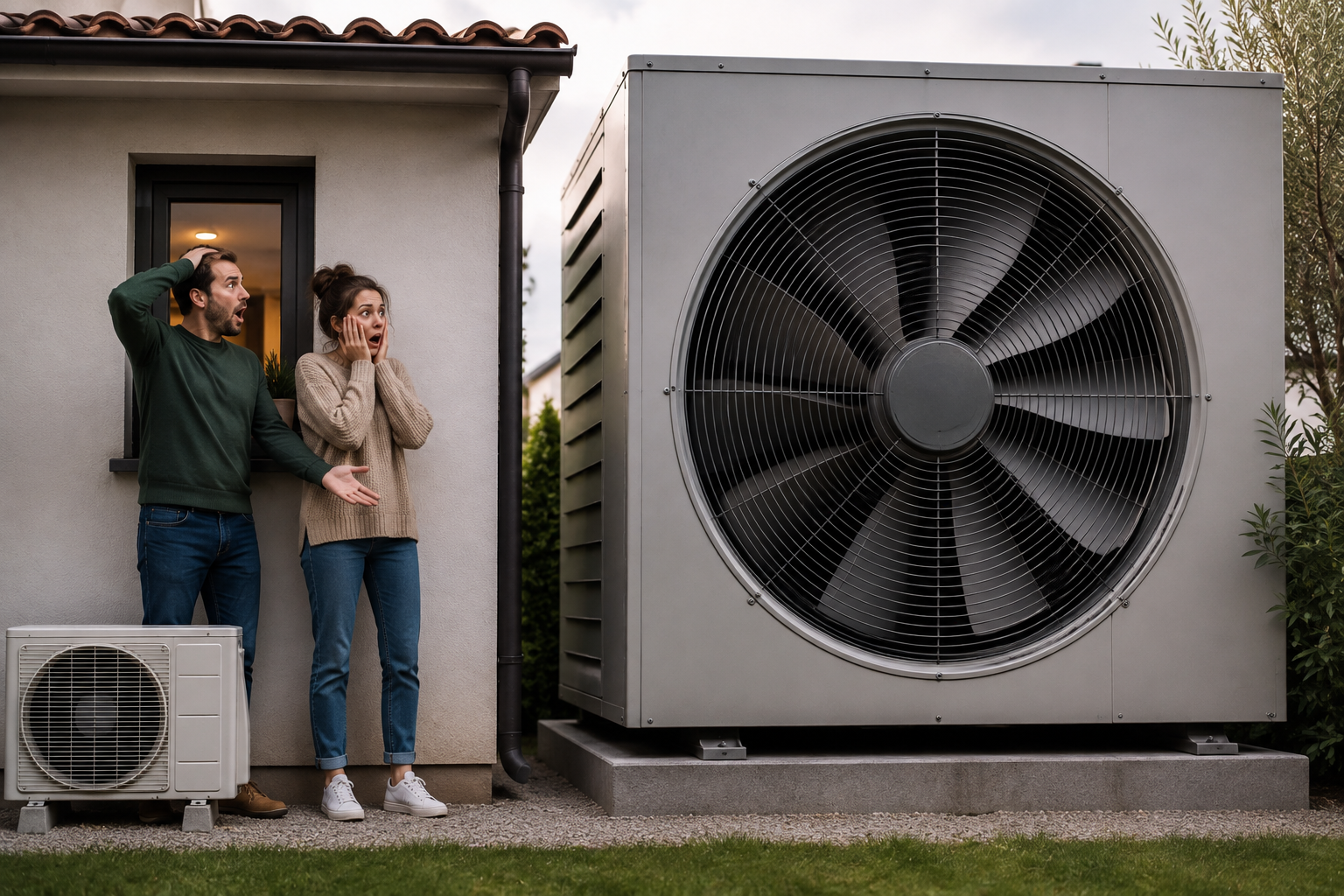
The oversizing mistake: the monster that turns on and off
Imagine buying a car. A car with a Formula 1 engine. Perfect for going grocery shopping two hundred meters from home. Every time you start, the engine screams. You arrive in an instant. You shut it off. You start again. The engine screams again.
That’s oversizing. Installing a heat pump that’s too powerful for your home. The unit reaches the desired temperature in ten minutes. The thermostat turns it off. Half an hour later, the temperature drops. The unit starts again.
This phenomenon is called “short-cycling.” The compressor spends its life switching on and off. The electrical inrush peaks at startup are very high. The bill swells. But there’s worse. The compressor wears out early. The unit’s service life is cut in half.
And it’s not over. An oversized unit cools or heats the air too quickly. It doesn’t have time to dehumidify the space. The result is a home at the right temperature, but with unbearable relative humidity. You’ll always feel too hot or too cold, depending on the season. Comfort disappears.
The undersizing mistake: the silent electric resistance
The opposite mistake is just as devastating. To save on purchase cost, people install a unit that’s too small. “It’ll never get that cold,” says the chronic optimist.
The heat pump works. It works at maximum output. But it can’t keep up. The indoor temperature doesn’t rise. The thermostat, desperate, activates the backup electric resistance heater. That famous “resistance” hidden inside the unit.
The electric resistance is a giant hair dryer. It has a COP of 1. For every kilowatt of electricity, it produces one kilowatt of heat. No magic. No savings. If your heat pump spends the winter running the resistance, your bill will be identical to that of an old electric boiler. Actually, worse. Because you’ll have paid ten thousand euros for a machine that’s useless.
The terminal-unit drama: old radiators and high temperature
Here we get to the heart of the Italian problem. Most Italian homes have cast-iron or aluminum radiators. They were designed to work with water at seventy degrees. The old gas boiler supplied it without problems.
A heat pump, instead, performs best with low-temperature water. Thirty-five, forty degrees. If you force it to produce sixty-degree water to satisfy old radiators, its COP drops vertically. It goes from 4 to 2, or even less.
Many installers tell you: “Keep your radiators, the heat pump can handle it.” Technically, maybe it can. Economically, it’s suicide. If you don’t want to replace radiators with larger low-temperature models, or if you can’t install underfloor heating, you must evaluate very carefully whether a heat pump is truly the right choice for your home. There is no magic wand.
Domestic hot water: the mistake that makes you take a cold shower
Everyone focuses on space heating. Everyone forgets domestic hot water. It’s a huge mistake. The heat pump must also produce water for the shower, the washing machine, the dishwasher.
Sizing the hot-water storage tank (the cylinder) is an art. If it’s too small, you’ll run out of hot water while you’re soaping up. The unit will have to start producing instant hot water, stealing energy from heating and throwing the system into chaos. If it’s too large, you’ll waste energy keeping a huge mass of water hot that you’ll never use.
You have to calculate peak demand. How many bathrooms are in the house? How many occupants shower at the same time in the morning? You need a properly sized tank, maybe with a dedicated coil or an intelligent integration system. It’s not a detail. It’s the difference between a refreshing shower and an involuntary Nordic bath.
The buffer tank: the lung that saves your life
There’s a component many try to eliminate to save space or money. The buffer tank, or puffer. It’s a tank that holds a certain volume of water. It seems useless. In reality, it’s the system’s life saver.
Modern heat pumps, especially inverter ones, modulate power. Sometimes they drop to very low outputs. If the water volume in the system is too small, the unit can’t dump the heat it produces. It overheats. It locks out.
The buffer tank solves the problem. It increases water volume. It allows the unit to run steadily. But it has another crucial function. It manages defrosting.
Defrosting: when the unit steals your heat to thaw itself
In winter, the outdoor unit of the heat pump ices up. It’s normal. Air humidity freezes on the coil. The unit must defrost. To do it, it reverses the cycle. For a few minutes, it steals heat from the water in your indoor system to melt the ice outside.
If there’s no buffer tank, or if it’s too small, the water reaching your radiators suddenly cools. The house takes a thermal hit. You feel yourself freezing. Then the unit restarts, consuming huge energy to raise the temperature again.
A properly sized buffer tank absorbs this thermal shock. The water in the tank compensates for the heat stolen for defrost. Your radiators stay lukewarm. You feel nothing. Comfort is saved.
Bureaucracy and incentives: when wrong sizing costs you the bonus
In Italy, the heat pump is often tied to tax deductions. 65% Ecobonus. Renovation bonus. To access these bonuses, there are precise technical requirements. The unit must meet certain COP and SCOP values.
SCOP is the seasonal coefficient of performance. It’s not a fixed number. It depends on how the unit operates in your specific home. If the unit is undersized, or if it’s forced to run at high temperature because of old radiators, its real SCOP collapses.
When the qualified technician has to certify the ENEA filing, they must enter the real data. If the data don’t meet legal limits, the filing is rejected. You lose the 65% deduction. You’ve spent twenty thousand euros more for nothing. Correct sizing isn’t only a comfort issue. It’s a bureaucracy-and-wallet issue.
Acoustic impact: the neighbor who reports you
Another aspect often ignored in sizing is noise. Heat pumps make noise. The outdoor unit has a compressor and a fan. If you size the unit poorly, it will always run at maximum output. The noise will be constant, annoying, penetrating.
Municipal regulations and noise laws impose strict limits, especially at night. If the unit exceeds allowed decibels, your neighbor can report you. You’ll be forced to turn it off at night, or spend thousands of euros on acoustic barriers. Choosing a unit with the right output, perhaps with a high-end inverter compressor and low-speed fans, is the only way to keep the peace with the neighborhood.
Managing the electrical grid: the meter that trips
Heat pumps are electric machines. They draw power. If you have a standard 3-kilowatt meter and install a 10-kilowatt heat pump, the meter will trip every time the unit starts.
It’s not enough to change the meter. You have to design the electrical system. You have to evaluate the contracted power. Maybe you need a load-management system that temporarily disconnects the oven or washing machine when the heat pump is running. Ignoring this aspect means living in constant fear that the power will go out while you’re watching a movie or cooking dinner.
The end of the DIY thermal era
The heat pump is an extraordinary technology. It’s the future of heating. But it’s not a toy. It’s not an appliance you buy sight unseen. It requires a design. It requires calculations. It requires expertise.
Getting the sizing wrong means turning a green investment into an economic nightmare. It means destroying your home comfort. It means fighting with neighbors and the tax authorities.
At Gruppo Impianti ristrutturazioni we don’t sell boxes. We design systems. We analyze your home. We calculate the heat load. We choose the right unit, the right terminals, the right storage. Because real savings aren’t buying the cheapest heat pump. It’s buying the one that truly works.
FAQ: The questions spinning in your head (and the answers that will save your bill)
Can I install a heat pump if I have old cast-iron radiators?
Technically yes, but it’s almost always a bad idea. Cast-iron radiators require high-temperature water (above 60 degrees) to heat well. At these temperatures, the heat pump’s efficiency (COP) drops drastically. Electricity consumption shoots through the roof. Before installing a heat pump, it’s essential to evaluate whether to replace the radiators with larger low-temperature models, or integrate the system with underfloor heating. If you can’t do that, carefully assess whether a heat pump is truly the right choice for you.
What exactly is “short-cycling” and why is it so harmful?
Short-cycling happens when the heat pump is oversized. The unit reaches the set temperature too quickly and shuts off. Shortly after, the temperature drops and the unit starts again. This constant on-off is disastrous. The electrical inrush peaks at startup consume a lot of energy. The compressor wears out early, reducing the unit’s service life. Also, the unit doesn’t have time to dehumidify the air, creating a humid, uncomfortable environment.
Is the buffer tank (puffer) really necessary, or is it just a way to make me spend more?
The buffer tank is almost always necessary, especially in radiator or mixed systems. It ensures a minimum water volume in the system, allowing the heat pump to modulate correctly without locking out. But its most important function is managing defrost. When the unit needs to thaw, it steals heat from the system. The buffer absorbs this thermal shock, preventing the radiator water from suddenly cooling. Without a buffer, thermal comfort collapses and consumption increases.
How do I know if my installer is doing a serious calculation or just guessing?
A serious installer won’t ask only for the home’s square meters. They’ll ask the year of construction, the thickness and type of wall insulation, the type of windows, the building’s orientation. They’ll talk about “heat load” and “UNI TS 11300.” They’ll present a detailed bill of quantities and a technical report. If the installer gives you a verbal quote or on a flimsy sheet of paper in five minutes, based only on floor area, they’re guessing. Run.
Does a heat pump work well even when it’s minus five degrees outside?
Yes, modern heat pumps work very well even in harsh temperatures, down to minus 15 or minus 20 degrees. However, their efficiency (COP) decreases as outdoor temperature drops. A correctly sized unit accounts for these extreme conditions. An undersized unit, instead, will struggle, activating the backup electric resistance and driving consumption up. The quality of the compressor and the refrigerant gas used are crucial for low-temperature performance.
Is it really possible to lose the tax bonus because of a sizing error?
Absolutely yes. To access the 65% Ecobonus, the heat pump must meet specific efficiency values (COP and SCOP) defined by law. The real SCOP depends on how the unit operates in your specific system. If the system is poorly designed (e.g., old radiators that require high temperature), the real SCOP drops below legal limits. The qualified technician won’t be able to certify the ENEA filing. You’ll lose the deduction. Correct sizing is the only way to ensure compliance with legal requirements.
Stop playing Russian roulette with your heating
You’ve read this far and you’ve understood that a heat pump isn’t an off-the-shelf product. You don’t buy it sight unseen. It requires study, analysis, and deep knowledge of thermodynamics. Tired of hearing promises of “zeroed bills” that then turn into bitter surprises? It’s time to rely on people who do it seriously.
Contact Gruppo Impianti Ristrutturazioni today. We won’t sell you the biggest heat pump.
We’ll sell you the right one.
Our HVAC engineers will carry out an accurate heat-load calculation, study your home’s envelope, and design an integrated system, complete with storage and smart management, tailored to your needs. We’ll guide you step by step through the bureaucratic jungle to ensure you can access all the tax deductions you’re entitled to. Don’t leave your comfort to chance. Write to us, call us, or come visit us.
We design the perfect climate, because real savings start with a serious project.