
The human being: a demanding tropical plant in a world of extremes
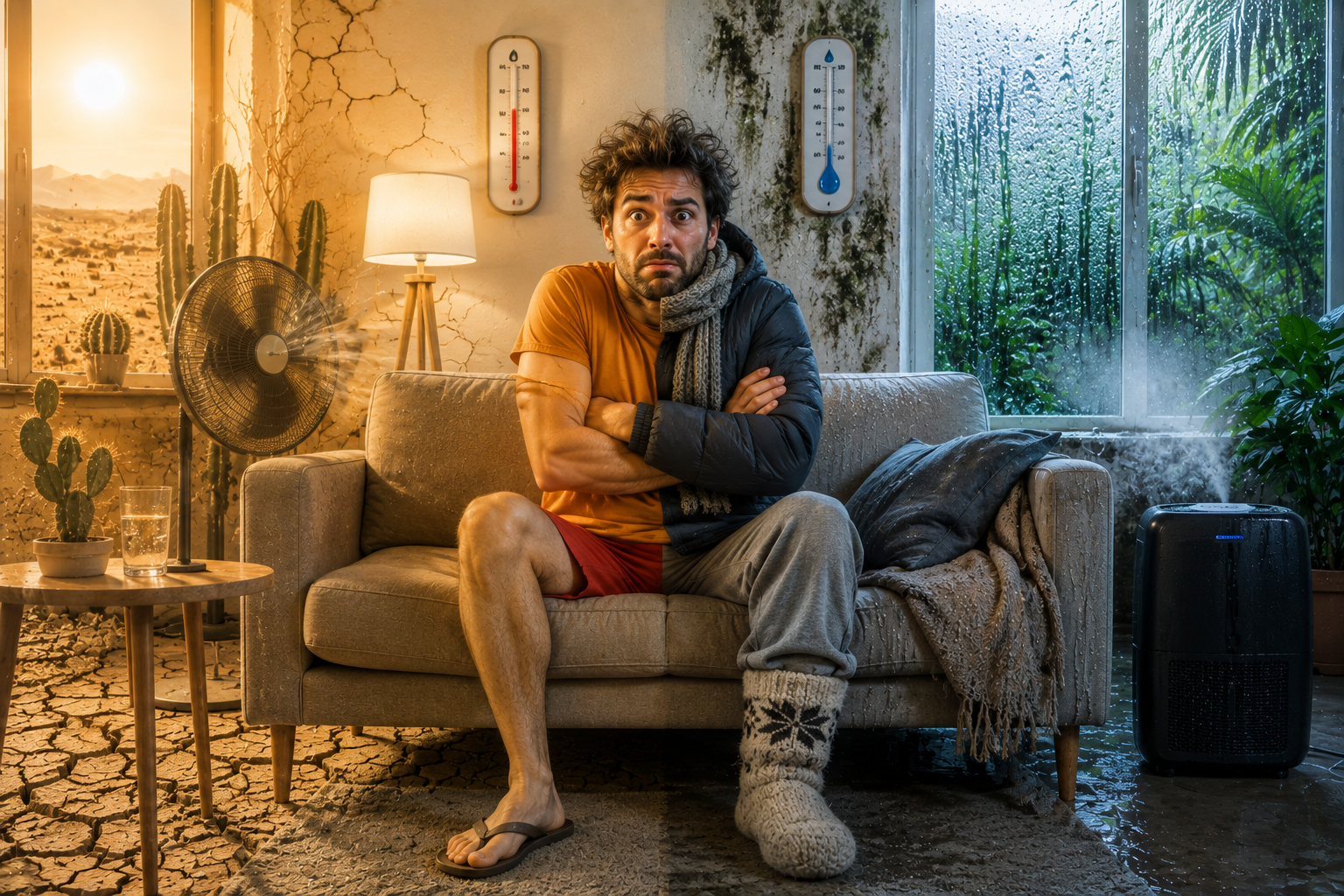
There’s a biological truth we tend to forget every time we buy a latest‑gen smart thermostat. Human beings are not internal-combustion machines. Not titanium robots. For all practical purposes, we’re extremely demanding tropical plants, wrapped in a shell of flesh that’s about sixty percent water. And like all tropical plants, we need very specific environmental conditions so we don’t wilt, rot, or go crazy.
The problem is that our modern homes, especially renovated ones built to the newest insulation standards, have become perfect thermoses. Airtight. And inside these thermoses, the microclimate can quickly turn into a Saharan desert or an Amazon swamp. The thermostat reads twenty-one degrees. Perfect. But your skin feels tight, your eyes burn, and you get zapped every time you touch the door handle. Or, on the contrary, you feel sticky, your breathing is heavy, and you notice a dark halo in the corner of the ceiling.
The thermostat lies. It only measures temperature. But comfort, health, and the very survival of your home depend on another factor, often ignored until it’s too late: relative humidity. Balancing the home microclimate isn’t a whim for aerospace engineers. It’s a physiological necessity. And doing it with grandma’s remedies is not only useless—it’s a downright insult to the laws of thermodynamics.
The science of humidity: why we’re not sponges
Before we get to solutions, we need to clarify a key concept. When we talk about humidity at home, we’re not referring to absolute humidity, i.e., how many grams of water are in a cubic meter of air. We mean Relative Humidity (RH). RH expresses the percentage of water vapor in the air compared to the maximum amount that air could hold at that specific temperature.
Warm air can hold more vapor than cold air. That’s the basic principle. If you heat cold, humid winter air without adding water, its relative humidity will drop dramatically. It becomes dry. Conversely, if you cool warm, humid summer air, relative humidity will shoot up, until it reaches the dew point and turns into condensation.
The comfort zone, defined by international standards such as ASHRAE (American Society of Heating, Refrigerating and Air-Conditioning Engineers) and reflected in Italian thermal-comfort regulations (UNI EN ISO 7730), lies between 40% and 60% Relative Humidity. Below 40%, the air is too dry. Above 60%, it’s too humid. Leaving this corridor means inviting discomfort, illness, and structural damage to move in with you.
The desert in the living room: when the air is too dry
Imagine it’s mid-winter. Outside it’s two degrees and raining. Inside, radiators (or underfloor heating) run full blast to bring the temperature to twenty-two degrees. The outdoor air, as it comes in and gets heated, loses its ability to hold moisture. The result? Indoor RH drops to 20% or even 15%. Welcome to the desert.
In such a dry environment, the human body starts losing water by evaporation at an unnatural rate. The mucous membranes of the nose and throat dry out. The respiratory defense system, called the “mucociliary escalator,” stalls. Viruses and bacteria, which under normal conditions would be trapped and expelled, find a clear path. That’s why we get sick more in winter: it’s not just the cold, it’s the dry air that disarms our defenses.
Skin becomes dry, itchy, and cracked. Eyes redden, especially if you wear contact lenses or spend eight hours in front of a computer. And then there’s static electricity. Dry air is an excellent electrical insulator. Charges build up on your clothes and body, discharging on the door handle or the cat’s snout with micro-shocks that feel like Taser hits.
The tropical swamp: when the air is too humid
Opposite scenario. It’s August. Or worse, it’s a shoulder-season day in a seaside city. Indoor RH goes above 70% or 80%. The air is dense, heavy. Sweat doesn’t evaporate from your skin because the air is already saturated. The body’s natural cooling mechanism fails. You feel hot even if the thermostat reads twenty-four degrees.
But the problem isn’t only comfort. High humidity is paradise on earth for your invisible, unwanted roommates: dust mites. Dermatophagoides thrive happily when RH exceeds 60%. Their droppings and remains are a leading cause of allergies and asthma, especially in children.
And then there’s her. Mold. Spores are always present in the air, but they germinate and colonize surfaces only when they find enough moisture. Above 65% RH, mold starts feeding on organic dust on walls, on shower silicone, and behind furniture. It’s not just an aesthetic issue. Some molds, like Stachybotrys chartarum, produce mycotoxins that are dangerous for respiratory and neurological health.
Improvised solutions (and why they insult physics)
Faced with these problems, the average person pulls out the repertoire of solutions passed down orally for generations. Solutions that are poetic, but technically disastrous.
Take the classic remedy for dry air: the little tray of water on the radiator. Or worse, the wet towel draped over a chair. Let’s do some math. A tray of water sitting on a hot radiator evaporates, at best, between 100 and 200 milliliters of water per day. To bring the humidity of a thirty-square-meter living room from 20% to 45%, you’d need several liters of evaporated water. The tray is a superstitious gesture. It has no real impact on the microclimate. The wet towel works a bit better, but it dries in two hours, then blocks transpiration and creates a perfect local environment for mold on the wall behind the chair.
For excess humidity, the improvised solution is: “Open the window!” Brilliant. Too bad that if it’s 85% relative humidity outside (typical of a summer day in the Po Valley or on the coast), opening the window doesn’t bring in dry air. It brings in a wall of water vapor. Indoor humidity will rise further.
Another improvised solution is the little box with chemical dehumidifying crystals. Those plastic boxes you buy at the supermarket, full of calcium chloride pellets that dissolve into water. They’re useful for dehumidifying the inside of a wardrobe or a shoebox. Putting them in a forty-square-meter living room is like trying to empty a swimming pool with a coffee spoon.
Geography dictates the microclimate
Here we get to the heart of the matter. Italy is a country with unique climatic complexity. There is no universal microclimate solution, because the problem changes radically depending on where you live. This is the GEO factor, and ignoring it means designing a system that will fail miserably.
If you live in the Po Valley (Milan, Turin, Bologna, Venice), your main enemy in winter isn’t the cold. It’s outdoor humidity, combined with fog and thermal inversion. Your homes, if well insulated, will retain internally produced moisture. In this area, winter dehumidification and MVHR (Mechanical Ventilation with Heat Recovery) are not optional. They’re mandatory for health. In summer, the mugginess is oppressive and dehumidification is the absolute priority, more than cooling itself.
If you renovate in a coastal area (Liguria, Upper Tyrrhenian, Adriatic), summer brings very high relative humidity, loaded with salt. The air is heavy. Here the air-conditioning system must have dehumidification capacity independent of temperature. Otherwise, to remove humidity, you’ll be forced to cool the house to eighteen degrees, catching terrible colds.
If you live in the mountains (Dolomites, Alps, high Apennines), the winter climate is cold and dry. Outdoor air has very low water-vapor content. When you heat it, indoor RH collapses. Here the problem is air that’s too dry. You need an active humidification system, especially if you have solid-wood floors or fine parquet, which shrink with dry air, creating unsightly gaps.
In Southern Italy and the Islands, summer is characterized by dry heat (sirocco) or humid heat (libeccio). Thermal insulation must be designed to delay heat ingress (phase shift), but managing indoor humidity produced by showers and cooking requires constant mechanical ventilation, since windows often can’t be opened due to heat or noise pollution.
MVHR: the silent hero of the home microclimate
If there’s one technology that has revolutionized the concept of microclimate, it’s MVHR—Mechanical Ventilation with Heat Recovery. But not the little bathroom fan. We’re talking about a centralized, ducted system that extracts stale, humid air from wet rooms (bathrooms, kitchen, laundry) and supplies fresh, filtered air into dry rooms (bedrooms, living room).
The real miracle of modern MVHR isn’t only air exchange. It’s the heat exchanger. But for microclimate, the real star is the enthalpy exchanger. This device, usually an enthalpy wheel or a plate exchanger made of hygroscopic material, transfers not only heat between outgoing and incoming air. It also transfers moisture.
In winter, the warm, humid air leaving the house (produced by you, showers, cooking) gives part of its moisture to the cold, dry air coming in from outside. The supply air won’t be as dry as the outdoor air. In summer, the opposite happens: warm, humid outdoor air coming in gives part of its moisture to the cool, drier air going out. The result is a natural balancing of humidity, without energy waste.
Active humidification: when the desert wins
In some situations, enthalpy MVHR isn’t enough. If you live in high mountains, or if your home is super-insulated and airtight (class A4), indoor humidity in winter will still drop below 30%. Here you need active humidification.
Forget ultrasonic humidifiers you place on the nightstand. They create local puddles of water, dampen furniture and, if not cleaned perfectly, spray bacteria and limescale into the air (the famous “white dust” that settles on black furniture).
The professional solution is a humidifier integrated into the ducted HVAC system. These are modules installed on the supply air. They can be natural-evaporation (air passes through a wet pad) or steam (a sterile steam generator injects pure steam into the air). These systems are controlled by a humidistat. When humidity drops below 40%, the system activates, bringing RH to 50% evenly throughout the home, without creating localized condensation.
Active dehumidification: when the swamp wins
Likewise, in summer or in humid shoulder seasons, MVHR may not manage to keep RH below 60%. You need active dehumidification.
Many people think it’s enough to set the air conditioner to “Dry” mode (droplet). Wrong. “Dry” mode on traditional air conditioners is a byproduct of cooling. To dehumidify, the unit must cool the air until water condenses on the indoor coil, and then (sometimes) reheat it slightly. The problem is that to dehumidify, you’re forced to cool the room. If it’s twenty-two degrees outside but 90% humidity, the air conditioner in “Dry” mode will freeze your home just to remove moisture.
The correct solution is a ducted dehumidifier, direct-expansion or hydronic. These machines are designed to dehumidify without cooling (or with minimal cooling that is compensated). They draw air from the room, pass it over a cold coil to condense water, then pass it over a warm coil (using the compressor’s waste heat) to reintroduce it into the space at the same temperature, but much drier. They can be integrated into the ducted system and controlled independently of the thermostat.
Home automation: the invisible butler that never sleeps
Balancing the microclimate manually is a full-time job. You’d need a hygrometer in every room and spend the day turning machines on and off. Home automation solves this problem, turning the house into a reactive organism.
Humidity and temperature sensors (often integrated into a single device) are placed in key rooms. These sensors communicate with the home-automation hub (via KNX, Zigbee, or Matter). The hub doesn’t look only at temperature. It looks at RH.
If RH rises to 65% in the living room, home automation activates the ducted dehumidifier, even if the temperature is perfect. If RH drops to 35% in the bedroom, it activates the steam humidifier. If the MVHR has a bypassable enthalpy exchanger, home automation can manage the flaps to maximize moisture recovery in winter and minimize it in summer.
All of this happens silently, in the background, without you having to touch a button. The house breathes for you. It keeps the environment in the “Goldilocks zone,” where it’s neither too dry nor too humid, but “just right.”
The impact on the home: it’s not only you who suffers
Don’t think the microclimate affects only your body. Your home is made of hygroscopic materials—materials that absorb and release moisture depending on the environment. Wood is the most obvious.
If you have a solid-wood parquet floor or high-quality engineered wood, that wood is alive. If RH drops below 35% in winter, the wood loses moisture, shrinks, and cracks. You’ll hear the “crack” of boards separating. If RH rises above 70% in summer, the wood absorbs moisture, swells, and the boards cup, creating the “pillow” effect. Keeping RH between 45% and 55% is the only way to guarantee the durability and beauty of your parquet.
Plasters and paints suffer too. Excess humidity causes breathable paints to peel and salt efflorescence to form. Air that’s too dry, combined with thermal swings, creates micro-cracking in lime plasters. A home with a balanced microclimate ages much more slowly.
The end of the era of improvised solutions
Balancing the home microclimate isn’t an option for the wealthy. It’s the baseline of a renovation done properly in 2026. We can’t afford to live in homes that make us sick, ruin our furniture, and force us to drape wet towels over chairs as if we were in the Middle Ages.
The technology exists. MVHR with enthalpy recovery, ducted dehumidifiers, integrated steam humidifiers, and home automation are mature, reliable solutions and, if designed well, energy-efficient. They require an upfront investment, yes. But the cost of not doing them is far higher: you pay in medical bills, in replacing ruined floors, in early renovations to remove mold.
At Gruppo Impianti Ristrutturazioni we don’t just lay pipes and cables. We design the ecosystem you’ll live in. We analyze the GEO factor, calculate internal moisture loads, and size air-treatment systems to ensure your home is always in perfect balance between desert and swamp. Because breathing well isn’t a luxury. It’s a right.
FAQ: The questions swirling in your head (and the answers that will save your lungs)
I have a latest-generation inverter air conditioner—doesn’t it already do everything (heat, cool, and dehumidify)?
No, and this is one of the toughest urban legends to kill. Your air conditioner is a machine designed to manage temperature (heat/cool). The “dehumidification” function (often shown with a droplet) is a secondary mode. To dehumidify, the air conditioner must cool the air so water condenses on the indoor coil. The result is that to remove humidity, it cools the room. In shoulder season, when it’s 20 degrees outside but 80% humidity, using “dry” mode will force you to stay indoors in a sweater because the temperature will drop to 16 degrees. Also, split units move a lot of air, creating annoying drafts and stratifying temperature. For true humidity control independent of temperature, you need a dedicated ducted dehumidifier.
Can MVHR with an enthalpy exchanger really humidify the air in winter?
Careful with terminology. Enthalpy MVHR doesn’t “humidify” the air in the sense of actively adding water. It recovers humidity. In winter, indoor air is humid (thanks to you, showers, cooking) and is about to be exhausted. Outdoor air is cold and dry and is about to enter. The enthalpy exchanger transfers part of the water vapor from the outgoing air to the incoming air. This mitigates the humidity drop, keeping it maybe at 35–40% instead of letting it crash to 20%. It doesn’t replace an active humidifier if the climate is extremely dry (e.g., high mountains), but it drastically reduces the need for active humidification and the consumption of water and energy to run it.
I want to put an ultrasonic humidifier in the bedroom. Is that a bad idea?
It depends on how much you care about your health and your furniture. Ultrasonic humidifiers break water into cold micro-droplets. If you use tap water, the limescale in the water is atomized and released into the air. It will settle on all furniture, fabrics, and your lungs as “white dust” (fine particulate). Also, if the tank isn’t cleaned and disinfected every two days, stagnant water becomes a breeding broth for bacteria and molds, which will then be sprayed directly into the air you breathe. If you really must use a portable humidifier, choose a natural-evaporation model (with a honeycomb filter) or a warm-steam model (which sterilizes the water by boiling it), and always use demineralized water. But the real solution remains the ducted system.
How can I tell if humidity at home is out of range without buying expensive instruments?
You don’t need thousand-euro instruments. A good indoor digital hygrometer from a reliable brand (like Netatmo, Xiaomi, or Govee) costs between 20 and 40 euros online. Buy two or three and place them in critical rooms: bedroom (where you spend 8 hours), living room, and bathroom. Check them in the morning as soon as you wake up. If RH is consistently below 35% or above 65%, you have a microclimate problem that must be addressed at the system level, not with wet rags.
My parquet is shrinking and gaps have formed between boards. Is humidity to blame?
99% yes, especially if it happens in winter when heating is on. Wood is a hygroscopic material. It has an “equilibrium moisture content” that settles around 8–10% when ambient RH is between 45% and 55%. If RH drops to 20% due to heating and lack of ventilation, the wood loses moisture, contracts, and boards separate. The solution isn’t replacing the parquet. The solution is installing a humidification system (integrated or high-quality portable) to bring RH back above 40%. In most cases, with the return of the humid season or with the humidifier running, the gaps will close on their own.
Can I manage humidity by opening the windows early in the morning in summer?
In theory yes: it’s a passive strategy called “free cooling” and “free dehumidification.” If you live in an area where outdoor relative humidity drops sharply at night and in the early morning (typical of inland or continental areas), opening windows from 5 to 7 a.m. can help expel humidity accumulated overnight. However, if you live in a coastal city or in the Po Valley, nighttime humidity is often very high due to dew and fog. In these cases, opening the window in the morning makes things worse. That’s why MVHR with automatic control is superior: it exchanges air when needed, filtering it and recovering energy, regardless of outdoor conditions.
Stop breathing at random—start designing your climate
You’ve read this far and you’ve understood that microclimate isn’t a detail. It’s the environment your lungs, your skin, and your home live in 365 days a year. Are you tired of fighting dry air that irritates your eyes, or humidity that makes you feel constantly hot and sticky? Are you tired of seeing your parquet get damaged or mold creeping in?
It’s time to stop relying on improvised solutions and move to comfort engineering. Contact Gruppo Impianti Ristrutturazioni today. Book a consultation for an analysis of your home’s microclimate and GEO factor. Our HVAC engineers will design an integrated system of Mechanical Ventilation, dehumidification, and humidification, perfectly calibrated to your local climate and your physiological needs.
Don’t let your home be a desert or a swamp. Write to us, call us, or come visit. We design the perfect air, because breathing well is the first true luxury.